USAID DEC
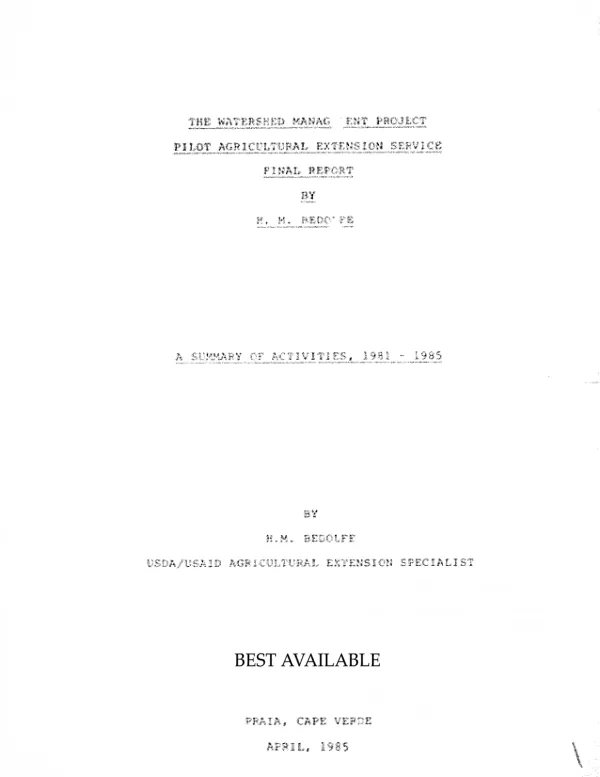
Watershed management project pilot agricultural extension service final report : a summary of activities, 1981-1985
Sign inUSAID. MISSION TO CAPE VERDE
Watershed management project pilot agricultural extension service final report : a summary of activities, 1981-1985
Evaluates component of watershed management project in Cape Verde to establish a pilot agricultural extension service directed at the small farmer.
Bedolfe, H. M. · 1985
Sign in to readA free account is required to download.
Abstract
Final internal report covers the period 1981-84; methodology is not given. Under the project, both dryland and irrigated land farmers have been able to improve their situations. The number of farmers receiving instruction or assistance has clearly exceeded the projected 1,500-2,000; specifically, the project has: trained 192 farmers in various aspects of vegetable production; provided 1,320 fruit trees (grown at Flamengos under project supervision) to 227 irrigated land farmers; cultivated 67,000 trees in nurseries during 1984 and 1985, which were either provided to 3,766 farm families for reforestation (mostly acacia americana) or used to plant arid land slopes in contour ditches; and assisted 917 farm families plant pigeon peas on steep, dryland slopes. The 4 extensionists and their coordinator have been trained in vegetable and fruit tree production, crop protection, reforestation, biological soil erosion control, and extension methods; they also received training on farmer interviews and farm surveys through participation in a mid-1984 farm survey, and in late 1984 began animal production training in Trinidad. The Program Director has undergone extension training at U.S. universities, and another Verdean has begun U.S. B.S. studies. While selecting young extensionist candidates from the valleys in which they are to work has preempted housing, transportation, and adjustment problems, the lack of formal agricultural training and relatively low level of education of these same has been a negative factor. The project has also developed linkages between extension and related units, particularly the Center for Agrarian Studies. However, the project could be improved by: recruiting women extensionists to promote cottage industry and nutrition among the 33% of households in the project area headed by women; marketing fresh produce more widely and over the course of the year; holding quarterly meetings among involved agencies; providing B.S. or M.S. training for the Director and increased training for extensionists on monitoring cultivated areas and crop yields. Several recommendations for follow on activities are given.