NEW TRANSCENTURY FOUNDATION
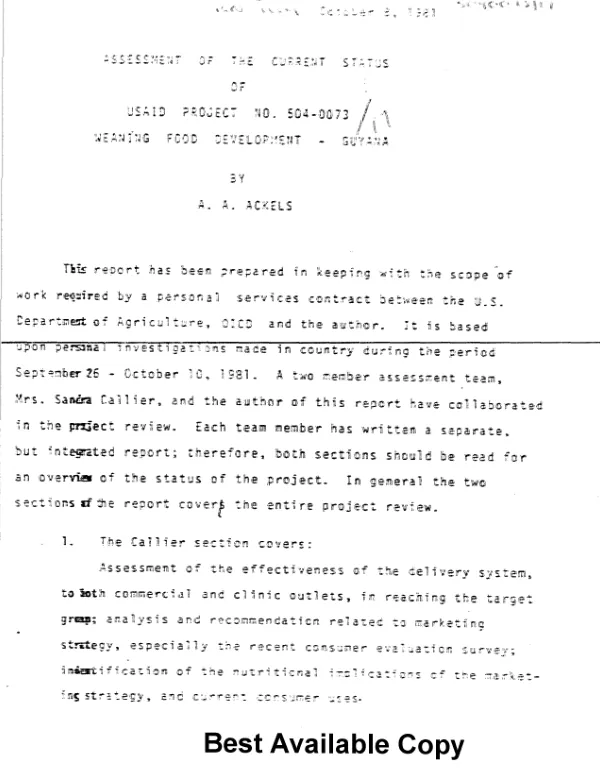
Weaning food development : an assessment of progress to date
Evaluates project to produce a food supplement, CEREX, to combat malnutrition in children under age 2 (secondarily, under age 5) in Guyana.
Callier, Sandra S. · 1981
Sign in to readA free account is required to download.
Abstract
Special evaluation, attached to a PES facesheet and another special evaluation (PD-AAJ0-601 and XD-AAJ-601-B), covers the period 10/79-10/81 and is based on document review and interviews with project staff during site visits. Preliminary pilot attempts in 6/81 at free distribution in mother/child health (MCH) clinics failed due to financial constraints and underdeveloped infrastructure. A revised system to control and report on product distribution, storage, and service delivery is as yet untested. CEREX sales are currently keeping pace with rising production levels, now at 820 MT/year, almost meeting project goals. CEREX seems to be reaching a high percentage of Guyana's 700 retailers, although some interior areas are being served inadequately or not at all. Preliminary data from a 6/81 survey indicate that of children under age 5 (47.8% of all CEREX consumers), 66.1% consume CEREX, and that of children under age 2 (18.7% of CEREX consumers), 70% have three servings a day, 18% two servings, and 12% one serving. Of the households surveyed, 74.3% had tried CEREX and 45.9% are current users. Non-use is attributed to other product preference or age. All income groups use CEREX to some extent due to its low price and the lack of alternatives, although based on food habits, more users tend to be Africans than East Indians. The current consumer price of G$0.38 per half pound provides a satisfactory retailer profit margin of up to 15%, but bears an unknown relationship to actual production costs. Current expenditures at 2 oz./child/day amount to G$45.50/child/year, or 3% of food expenditures for lowest income families. The priority recommendation is to determine CEREX's production cost - future planning strategy and the decision whether to continue on to phase II depend on these cost data. It is also recommended to: analyze separately CEREX's contribution to other, economic objectives; explore alternatives to a phase II of the project; have USAID/G, if requested, assist the Government of Guyana in testing future promotional work and the adequacy of the current mode of CEREX preparation and feeding, and design and evaluate an MCH distribution system.