DAI
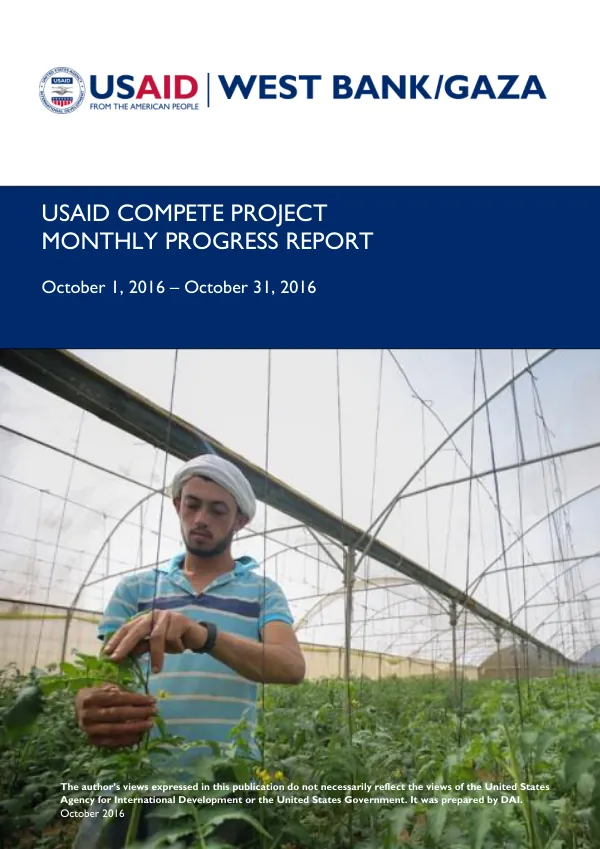
Weekly Progress Report May 13-24, 2012
The Compete Project is a USAID-funded initiative aimed at promoting economic growth and development in the West Bank and Gaza.
2012 · 24 pages
Sign in to readA free account is required to download.
Abstract
The project focuses on two key sectors: agribusiness and tourism. The reporting period for this progress report spans from May 13th to May 24th, 2012. In the agribusiness sector, the Palestinian Delicatessen Pavilion was established at the Fancy Food 2012 exhibition in New York. The pavilion featured six booths showcasing products from five Palestinian companies, including pickled cucumbers, Medjool dates, olive oil, and Dead Sea sea salt. A cooking station was also set up to promote Palestinian produce, and a recipes booklet of traditional Palestinian cuisine was published and distributed. The pavilion aimed to maximize sales and increase market exposure for Palestinian products. The Compete Project also organized an International Accreditation Workshop in Ramallah on May 16th, in collaboration with the Palestinian Standards Institute (PSI). The workshop, attended by 52 participants, provided training on international accreditation norms to help Palestinian companies compete in the global market. As a result of the workshop, eight laboratories expressed interest in obtaining international accreditation. The project team also conducted a technical assessment of the aquaculture farming sector in the West Bank, with a focus on the economic feasibility of using water in the region. The assessment was conducted in collaboration with the Arab Development Society (ADS), which has established a fish ponds and fingerlings demo farm in Jericho. In addition, the Compete Project visited Al-Quds Company, a producer and packer of Medjool dates and eggplant, to explore opportunities for collaboration and knowledge sharing. The project team will conduct field demonstrations with Al-Quds Company and farmers from the region to promote best practices in water management using new magnetic technology. The project team also attended the Water Crisis Conference at the Palestine Technical University (PTU) in Tulkarem, where key speakers discussed future trends in agricultural water management, reuse regulations, and water harvesting techniques. The conference highlighted the success story of the USAID-funded Olive supplementary irrigation demo in the region. In terms of project activities, the Compete Project team conducted consultant selection and interview, drafted statements of work (SOW) for project activities in nurseries, and conducted gap assessments for laboratories and nurseries. The team also met with stakeholders from the Fresh Herbs industry to create a Fresh Herbs Organization and with the Palestinian Food Industries Association (PFIA) to create a qualified team and system to assist food processing companies in upgrading and improving their packaging and labeling. In the tourism sector, the Compete Project has been working with industry stakeholders to develop a site renovation prioritization plan and to assess the tourism potential of archaeological sites in the Palestinian territories. Two industry working groups have taken place since the last report, and a full evaluation criteria has been developed and presented by the Compete Project. The working group will participate in the assessment of the shortlisted sites, and the next steps will be to undergo a detailed assessment of these sites.
Related documents