USAID DEC
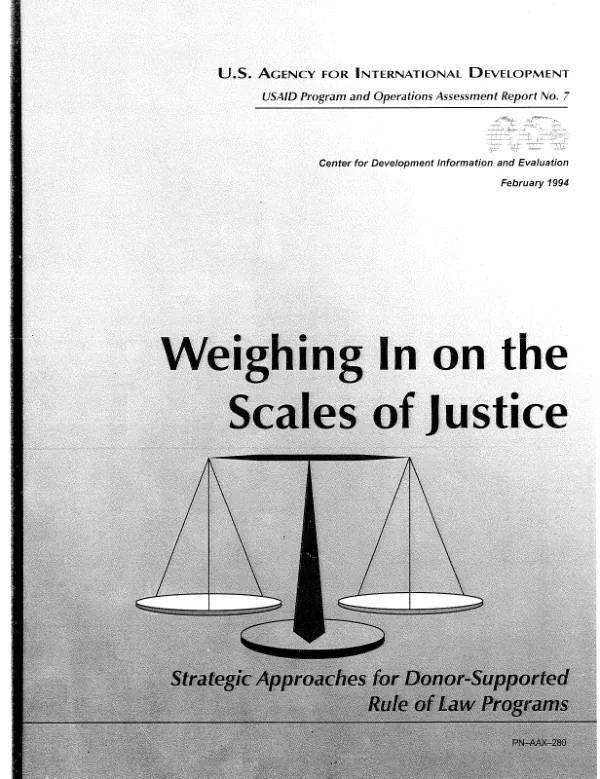
Weighing in on the scales of justice : strategic approaches for donor-supported rule of law programs
Sign inUSAID. BUR. FOR POLICY AND PROGRAM COORDINATION. CENTER FOR DEVELOPMENT INFORMATION AND EVALUATION (CDIE)
Weighing in on the scales of justice : strategic approaches for donor-supported rule of law programs
The development of legal systems in support of the Rule of Law has emerged as a major goal of USAID's democracy portfolio.
Blair, Harry|Hansen, Gary E. · 1994
Sign in to readA free account is required to download.
Abstract
This study, based on field work in six countries (Argentina, Colombia, Honduras, the Philippines, Sri Lanka, and Uruguay), assesses the recent Rule of Law experience of USAID, the Asia Foundation, and the Ford Foundation, all longtime donors in the justice sector. The study identifies four alternative, although often complementary, strategies for legal development. In sequential order, these are: building political support for reform; establishing adequate legal system structures; making these structures accessible and equitable; and strengthening existing legal structures. Lessons pertaining to these strategies are summarized. (1) Building of political support is critical, but donor efforts in coalition- and constituency-building have often failed. The commercial sector can offer valuable support, as can bar associations, while a free press is essential. (2) Structural reform is a formidable challenge, but sometimes it is more rewarding to create new institutions than to reform entrenched ones. Efforts to introduce merit-based career systems and oral trial procedures have succeeded in several of the countries. Any reform process that does not include mechanisms to ensure enforcement will likely prove ineffective. (3) Legal advocacy NGOs represent the most promising strategy for improving legal access for the poor, while alternative dispute mechanisms are also attractive, although they need close supervision. More conventional means (e.g., legal aid, legal literacy campaigns, paralegal training) are effective when integrated around specific issues. (4) Strategies for legal system strengthening, pursued in all six countries, include traditional institution-building efforts such as improving court administration and training judicial personnel. Successful components of strengthening vary widely among countries; understanding the reasons for court delays is an essential, but almost always difficult task. In conclusion, the study discusses several cross-cutting lessons.
Related documents