USAID. MISSION TO SUDAN
Western Sudan agricultural research project
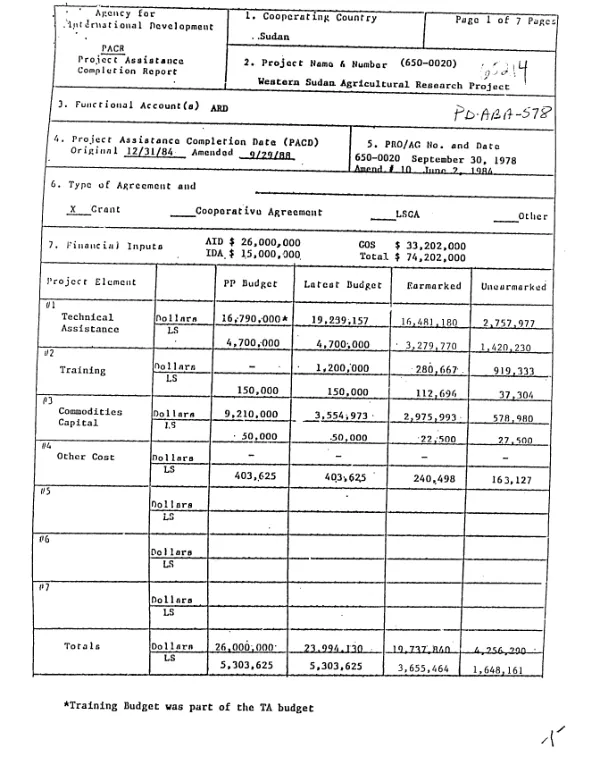
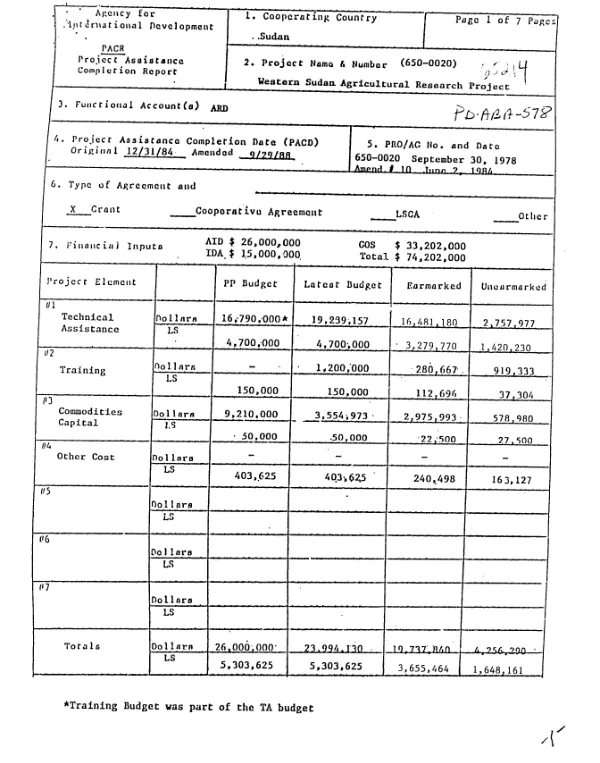
PACR of a project (1978-1988) to increase the capability of Sudan's Agricultural Research Corporation by constructing research facilities and assisting in the initiation of research programs.
1990
Sign in to readA free account is required to download.
Abstract
The project succeeded in providing the basic infrastructure and personnel for an agricultural research system in western Sudan. However, overall progress was seriously constrained by problems at each of the four research stations. Construction of the two research stations in Darfur -- El Fasher and Ghazala Gawazat -- was delayed by four years due to governmental policy changes, material shortages, an adverse political climate, and poor management by the contractor. Neither station is functional. A director and supporting staff were recently appointed at El Fasher, but research activities are not yet begun. Work at Ghazala Gawazat is at a standstill due to uncertainty over which government Ministry is responsible for the station. However, project activities in Darfur will continue, utilizing funding from the World Bank and the Western Savana Development Corporation. The other two research stations, while delayed, are now reasonably well staffed and are carrying out the proposed research activities at satisfactory levels. At Kadugli, a survey was conducted to identify major production constraints. Suitable technical and management methods were then tested at the station before being implemented in the fields of participating farmers. However, on-farm research was only partially achieved because of administrative and logistical problems and impassable roads during the rainy season. The El Obeid station had a limited staff, which constrained research efforts in 1983 to a less interdisciplinary program than at Kadugli. In 1985, however, on-farm trials and other adaptive research activities were conducted. Project training was relatively successful, including 7 Ph.D.'s, 8 M.Sc.'s, and 43 participants in specialized nondegree courses. Two major lessons were learned. (1) Recruitment, training, and retention of project personnel must receive the highest priority in agricultural research and development activities. (2) The length of time required to complete a project must be carefully planned, especially for projects with large construction and infrastructure components.
Related documents
![Final evaluations of the food crops research project (655-0011), the watershed development project (655-0013) and the PL 480 Title [II] 206 program and design recommendations for a consolidated project](https://covers.devme.ai/gen/6670.webp)