THE INTERNATIONAL EXECUTIVE SERVICE CORPS
WHAM Quarterly Program Performance Report, Apr 1– Jun 30, 2020
The Workforce and Higher Access to Markets (WHAM) Activity in Bosnia and Herzegovina (BiH) aims to stimulate job creation by advancing BiH's trade integration with the European Union (EU) and regional markets.
2020 · 32 pages
Sign in to readA free account is required to download.
Abstract
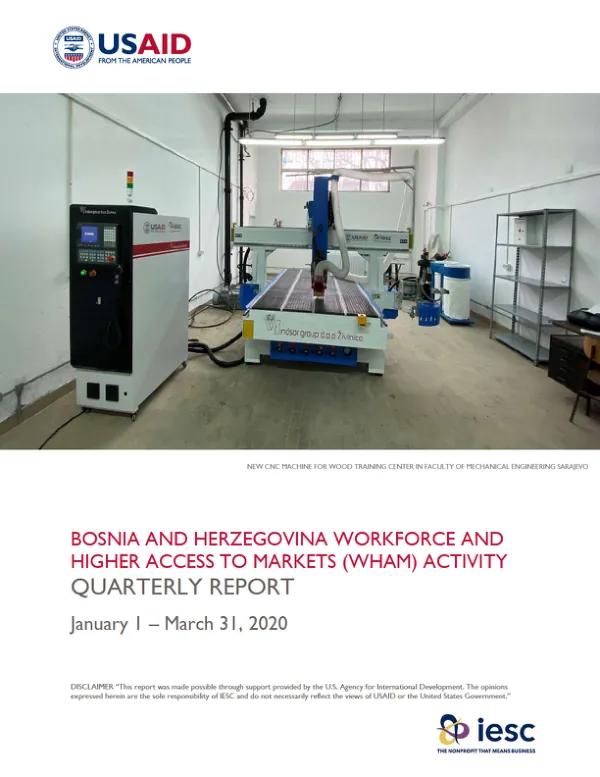
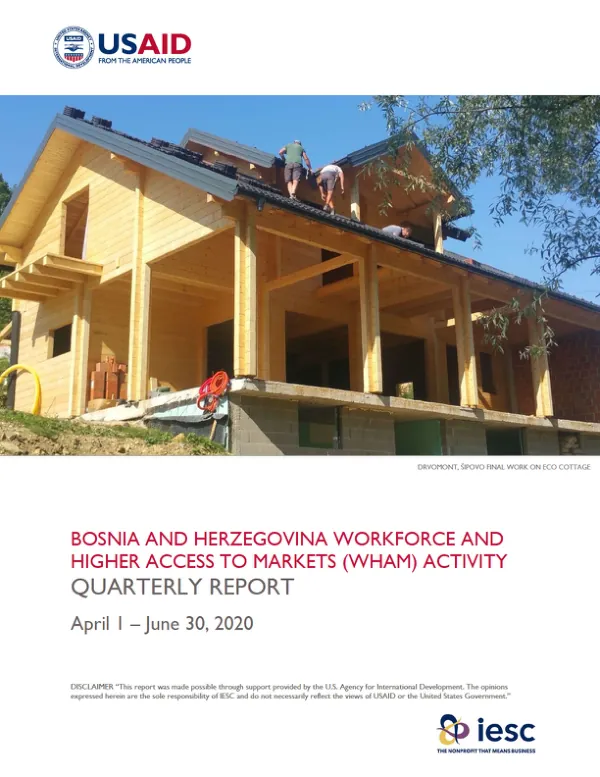
The Activity is implemented by the International Executive Service Corps (IESC) in conjunction with local sub-recipient ENOVA, and is funded by the United States Agency for International Development (USAID). The WHAM Activity focuses on BiH private enterprises, prioritizing high-growth, exporting, or export-ready enterprises aiming to expand capacity, reach more markets, and generate employment. The Activity includes three key intervention areas: Workforce Development, Access to Markets, and Product Quality and Capacity Building. Workforce Development aims to help the BiH workforce gain the skills needed for employment in high-growth enterprises. Access to Markets supports high-growth enterprises in identifying and accessing new customers in existing or new markets to increase exports from BiH. Product Quality and Capacity Building enables enterprises to meet the product and quality requirements of target markets in the EU and the region. In the extension period, the WHAM Activity included two additional intervention areas: Workforce Training Grants and Educational Centers of Excellence Grants. Workforce Training Grants serve immediate, specific training needs with capacity building packages that are completed in three to six months' time. Educational Centers of Excellence Grants help develop and showcase cutting-edge workforce training and re-training learning centers in a targeted sector. The WHAM Activity has a total of 23 active grants, with 4 new grants signed and 10 successfully completed during the reporting period. From the public call for RFA 009, the WHAM Activity team received and reviewed 73 applications, ultimately selecting seven applications to receive grant support. The Activity received 63 applications from the public call for RFA 010, which was published on June 5, 2020 and closed on June 29, 2020. Due to the COVID-19 pandemic, the WHAM Activity faced significant delays in implementation, with many grantees requesting extensions of activities to later months. The WHAM team suspended most travel to the field and kept the WHAM Sarajevo office open on a rotational basis. Despite these challenges, the Activity managed to disburse USD for grant activities, with a total of USD disbursed as of June 30, 2020. The WHAM Activity has supported various companies in BiH, including NovoForm, STEP, TRI BEST, Milinković, Edengarden, Dizart, and Kovan. These companies have faced challenges due to the pandemic, including supply chain disruptions and social distancing restrictions. However, some companies have managed to move forward despite these challenges, such as INTERA, which organized the "Training of the Trainers Program" for CNC trainings. The WHAM Activity has also supported the development of educational centers of excellence, including the Faculty of Mechanical Engineering University of Sarajevo, which has established a center for workforce training and re-training. The Activity has also supported the development of product quality and capacity building, including the establishment of a quality management system by the company Dizart. The WHAM Activity has a strong focus on supporting small to medium-size enterprises (SMEs) in BiH, with a particular emphasis on the wood processing, metal processing, textile/apparel, and information and communications technology (ICT) sectors. The Activity has also supported the development of business-to-business (B2B) relationships between BiH companies and EU companies, with a view to increasing exports from BiH. Overall, the WHAM Activity has made significant progress in supporting the development of BiH's private sector, particularly in the areas of workforce development, access to markets, and product quality and capacity building. Despite the challenges posed by the COVID-19 pandemic, the Activity has continued to support the development of BiH's private sector, with a focus on SMEs and the wood processing, metal processing, textile/apparel, and ICT sectors.