RICE UNIVERSITY
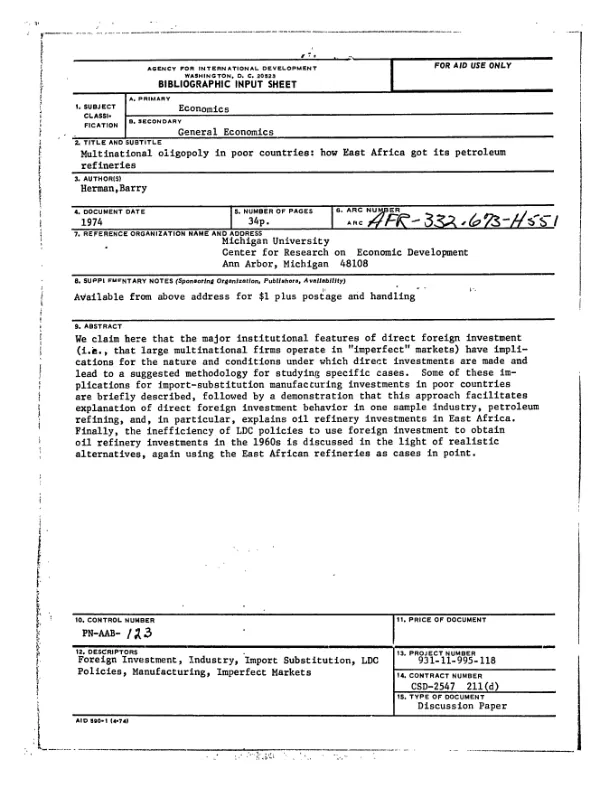
What to do about foreign direct investment, a host country perspective
The paper is organized as follows.
Morley, S. A. · 1970
Sign in to readA free account is required to download.
Abstract
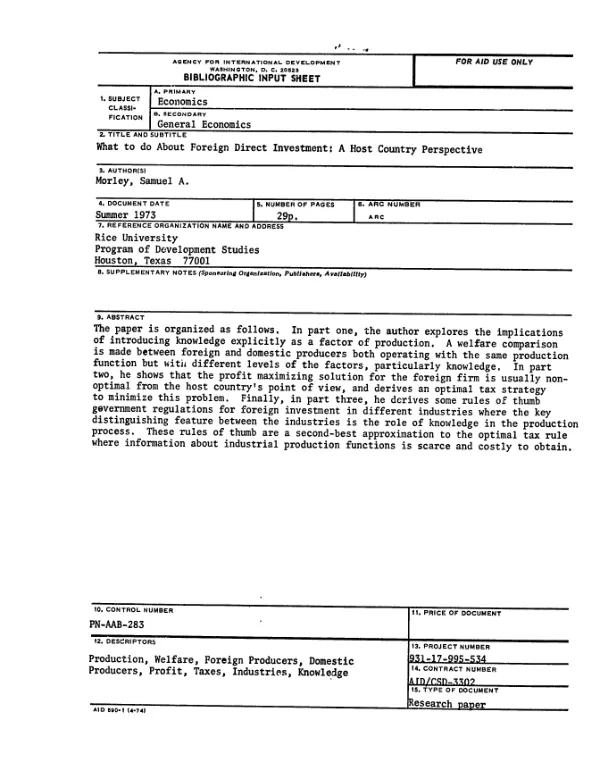
In part one, the author explores the implications of introducing knowledge explicitly as a factor of production. A welfare comparison is made between foreign and domestic producers both operating with the same production function but with different levels of the factors, particularly knowledge. In part two, he shows that the profit maximizing solution for the foreign firm is usually non-optimal from the host country"s point of view, and derives an optimal tax strategy to minimize this problem. Finally, in part three, he derives some rules of thumb government regulations for foreign investment in different industries where the key distinguishing feature between the industries is the role of knowledge in the production process. These rules of thumb are a second-best approximation to the optimal tax rule where information about industrial production functions is scarce and costly to obtain.
Connected topics