USAID DEC
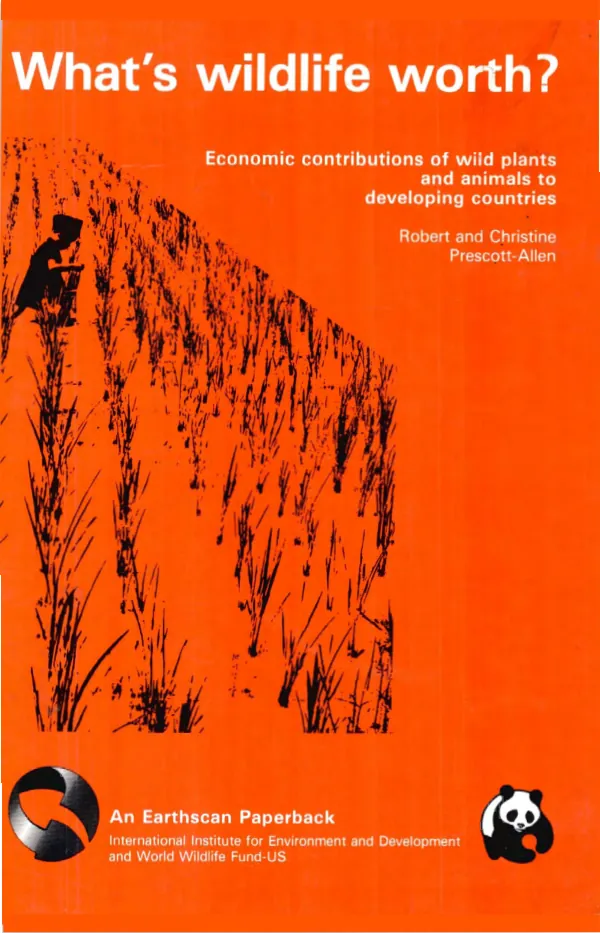
What"s wildlife worth? : economic contributions of wild plants and animals to developing countries
Sign inINTERNATIONAL INSTITUTE FOR ENVIRONMENT AND DEVELOPMENT
What"s wildlife worth? : economic contributions of wild plants and animals to developing countries
Even in the wake of the agricultural revolution, wild plants and animals remain economically significant for developing countries, according to this report.
Prescott-Allen, Robert; Prescott-Allen, Christine · 1970
Sign in to readA free account is required to download.
Abstract
Animal resources cover the gamut from marine species such as fish and shrimp to land animals ranging from frogs and lizards to small wild animals and larger game. Plants are exploited for edible leaves, roots, fruits, and nuts, and for non-edible, useful vegetative matter. Traditional uses of wild plants and animals are many and varied, ranging from nutritional (offering dietary nutrients and variety) to medicinal (as in Ayurvedic and other traditional health systems), and from practical (as when used for fuelwood or trade items) to scientific (as when used for genetic research to strengthen producing varieties). While critical to maintaining balanced ecosystems, indigenous wildlife is threatened even while beginning to be recognized for its intrinsic worth. Evaluation of the economic, cultural, and ecological import of wildlife, while complex and difficult, is necessary in order to provide hard data on which to base inclusion of wildlife conservation programs in national development strategies. An 8-page bibliography is appended (1953-82).
Connected topics