USAID DEC
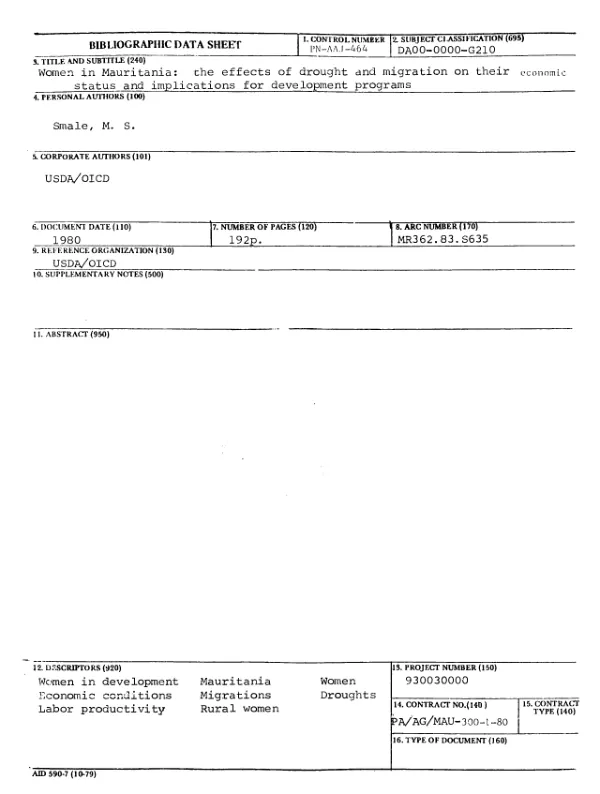
Women in Mauritania : the effects of drought and migration on their economic status and implications for development programs
Sign inU.S. DEPT. OF AGRICULTURE. OFC. OF INTERNATIONAL COOPERATION AND DEVELOPMENT
Women in Mauritania : the effects of drought and migration on their economic status and implications for development programs
What effects did the drought of the 1970"s and male migration have on the lives and income-generating ability of Mauritanian women?
Smale, Melinda · 1970
Sign in to readA free account is required to download.
Abstract
This report, based on a study of selected sites in Mauritania, answers that question. A Mauritanian woman"s ability to earn an income is largely dictated by her ethnic group. A Peulh woman, for example, can earn a small income by selling crops grown on a portion of her husband"s land, while a Bidan woman proves her status and wealth through inactivity. As self-proclaimed cultivators, Soninke women earn cash for family or personal needs by farming. Drought and migration are not new to Mauritania, but the drought of the last 10 years increased and lengthened male absences. Women have responded and adapted in their own characteristic way. Peulh women have become increasingly dependent upon agriculture for income, growing new dry-season crops. Many Toucouleur women have sought new occupations, traveling to and from urban centers to buy and sell small goods. Bidan women, lacking skills and hindered by social stigma, engage in only sporadic leatherworking and matmaking. Many Bidan families have found themselves subsisting entirely on charity. In the past, assistance to drought-stricken areas has concentrated on providing food, medical services, and goods. Investment in income-earning activities for women has been limited to establishing educational centers to promote the preservation of sewing and artisan skills. Recommendations to increase women"s income from productive activities are: (1) provide women with plots, seeds, fertilizers, tools, and wells or pump use; (2) encourage the growing of crops that can be staggered over a long season, easily stored or dried, and have greater market value than the vegetables currently produced; (3) subsidize and monitor women"s savings and investment associations, providing training in accounting, marketing, or small enterprise; (4) include women in crop experiments and demonstrations; (5) promote the raising and improved tending of household animals; and (6) explore the use of forestry byproducts and seedlings as sauce, food, and/or sales sources. Appendices include a 52-item bibliography (1952-80) and English footnote translations.
Related documents