USAID. MISSION TO BANGLADESH
Women"s enterprise development
Project to strengthen the capacity of the Bangladesh Small and Cottage Industries Corporation"s (BSCIC) Women"s Entrepreneurship Credit Program (WED-1), which makes loans to informal businesses managed by women.
1992
Sign in to readA free account is required to download.
Abstract
WED-1, which was a pilot activity under Project 3880042, combines "anti-poverty" (under $300) with "microenterprise or growth-oriented" ($300-$1500) lending. The project will implemented by BSCIC"s Women"s Entrepreneurship Development Program (WEDP) Unit. Under the first component, the WEDP Unit will increase its sustainability and assume increasing responsibility for its operations from BSCIC, which under WED-1 played a significant administrative role in the Unit"s operations. The Unit will make progress toward (though it will not achieve) financial self-sufficiency by increasing efficiency and loan recovery, making more loans, and making every effort to charge interest rates more in line with costs. Activities will be as follows. (1) The WEDP Unit will strengthen its personnel capacities by adding a financial manager and a rural credit advisor to its headquarters staff and a second fieldworker at each field office, and by developing a field performance incentive system. (2) The Unit will assume full responsibility for administering the credit fund from the Bangladesh Krishi Bank (BKB), which co-managed the fund under WED-1. (3) The Unit will adopt a new credit management system, which will, inter alia, streamline loan administration; target loans for all poor women engaged in informal enterprise (without preference for manufacturing and industry); and abolish the limit of 3 loans per borrower. The system will include a simple loan approval process for 10,000-60,000 loans (which will use inventory as collateral); include a computerized management information system; initiate regular cash flow projections; and track interest earnings at the field office level. In addition, the Unit will improve its loan accounting system. (4) Training will include training in the new system for senior staff, borrower assistance and loan monitoring training for field staff, and short-term third-country training and study tours in entrepreneurship development and business management for WEDP officers and senior staff. (5) In the project"s third year, the Unit will convene a Committee on Future Directions (comprised of representatives of the public and private sector, and NGOs), which will issue a policy statement and develop an action plan for institutional development, possibly incorporating the goal of privatization. Under the second component, project funds will be used to capitalize the WEDP Unit"s credit fund; in addition, the Government of Bangladesh will transfer funds remaining in WED-1"s credit fund (amounting to $350,000) to the WEDP Unit"s credit fund. This component will also finance geographic expansion of WEDP activity, with 10-20 new field offices to be added over the life of the project. The final component, microenterprise facilitation, beginning in the third year, will help the WEDP Unit to develop methods to recruit managers of growth-oriented firms as project borrowers. USAID"s disbursement to the WEDP credit fund after the middle of the third year will depend in part on field offices" success in making larger, growth-oriented loans; by project end, at least 15% of all loans will be growth-oriented. The project will include the development of borrower support services, including training. All new growth-oriented borrowers will be required to attend a 1-2 week business administration/financial management course.
Related documents
Documents in this collection
 1996
1996USAID DEC
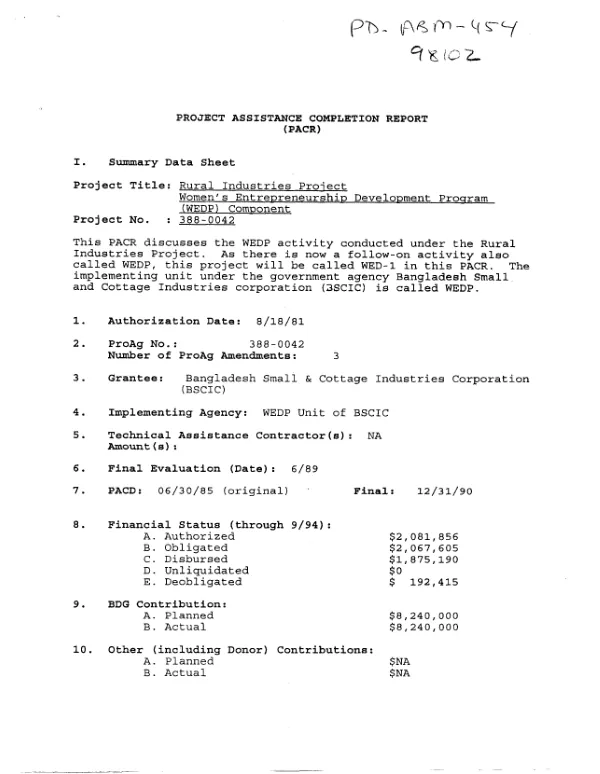
Project assistance completion report (PACR) : rural industries project -- women's entrepreneurship development program (WEDP) component
Open record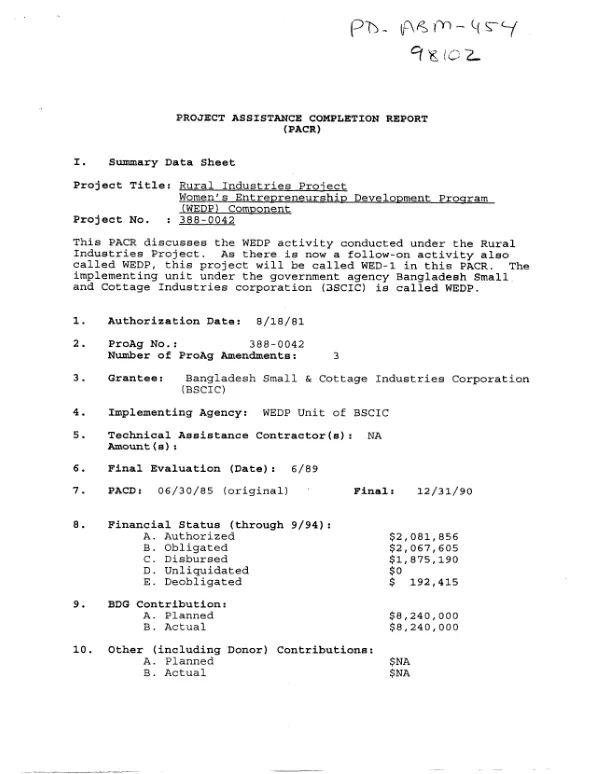 1996
1996USAID DEC