USAID DEC
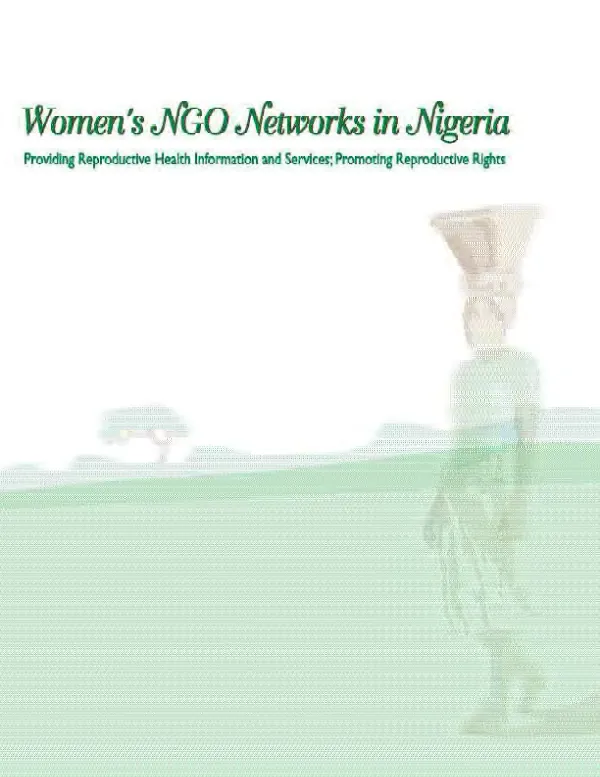
Women"s NGO networks in Nigeria : providing reproductive health information and services -- promoting reproductive rights
Sign inNGO NETWORKS FOR HEALTH
Women"s NGO networks in Nigeria : providing reproductive health information and services -- promoting reproductive rights
This study documents the activities and effectiveness of 51 networks of women"s NGOs delivering reproductive health (RH) information and promoting women"s reproductive rights in Nigeria.
2001
Sign in to readA free account is required to download.
Abstract
These women"s networks contribute immeasurably to the well-being of their members and the communities they serve. Specifically, the networks: (1) reach significant numbers of women, men, and children with their services, information, and advocacy and mobilization activities; (2) participate in a wide range of RH activities, including the provision of family planning services and products, individual counseling, and community education on RH issues, including HIV/AIDS and harmful traditional practices; (3) provide a trusted source of RH information and services; (4) work with traditional and religious leaders to neutralize resistance to contraception, end harmful traditional practices, and raise awareness of women"s reproductive rights; (5) link their efforts with those in other sectors to increase effectiveness and legitimacy; (6) help institutionalize democratic practices and values among their members and beneficiaries; and (7) contribute to the foundation of civil society. Key challenges for the future are to improve managerial and administrative capacity; improve technical capacity to deliver RH information and services; diversify funding sources; advocate for government recognition of women"s NGO networks" contributions and legitimacy as full partners in development; and strengthen internal democratic governance. Among the numerous lessons learned detailed in the study are the following: (1) The most effective and sustainable women"s networks were created by NGOs and community-based organizations to address specific, identified problems and functioned informally before formalizing their operations. (2) Integrating RH activities into programs implemented by women"s networks is an effective strategy to increase women"s access to RH information and services. (3) Shifting funds away from the NGO sector to the Nigerian government will have devastating effects on civil society and the RH sector. (4) Funding of women"s networks is most effective after local stakeholders have established ownership of the network and request support for specific programmatic and institutional needs. (5) Training and TA seldom strengthen the effectiveness and sustainability of women"s NGO networks because the networks lack the resources needed to apply newly acquired knowledge and skills. (6) A network"s structure is a major factor in the sustainability of the RH services it provides as well as the support it is likely to receive from beneficiaries. (7) Literacy is a critical component of a holistic strategy for promoting women"s social, economic, and political empowerment and welfare. Includes recommendations.
Related documents
![Midterm evaluation of the PROFAMILIA [Asociacion Pro-Bienestar de la Familia Nicaraguense] diversification, sustainability, and social marketing grant](https://covers.devme.ai/gen/5467.webp)
![Midterm evaluation of the PROFAMILIA [Asociacion Pro-Bienestar de la Familia Nicaraguense] diversification, sustainability, and social marketing grant : executive summary](https://covers.devme.ai/gen/72986.webp)
![Groupe Pivot/Sante Population [Pivot Group in Health and Population] : profile of a health network](https://covers.devme.ai/gen/83426.webp)