WORLD RELIEF CORP.
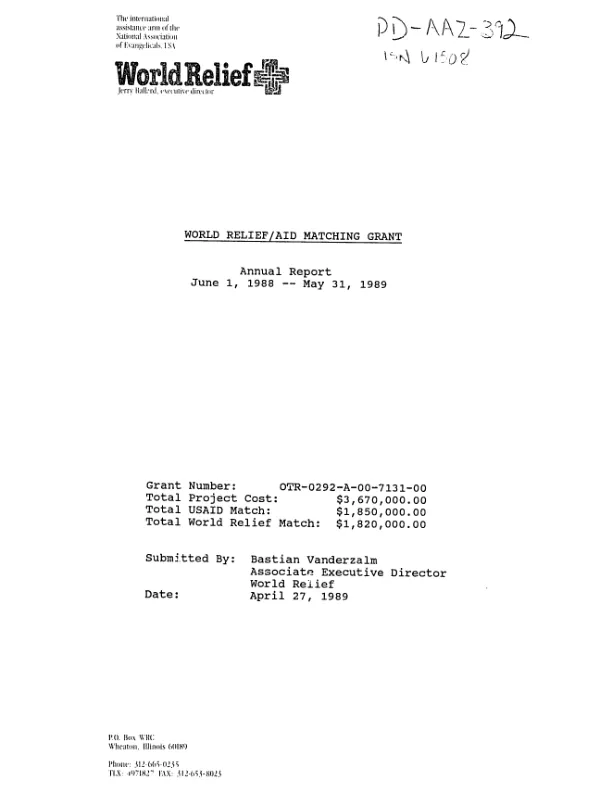
World Relief/AID matching grant : annual report, June 1, 1988 -- May 31, 1989
In 6/87, World Relief (WR) received a 5-year matching grant to provide TA in income generation to its counterpart organizations.
1989
Sign in to readA free account is required to download.
Abstract
Activities funded under the grant included the appointment of an income generation technical specialist at the WR headquarters, the use of workshops and other training methodologies to develop income generation capabilities among seven counterparts organizations (in Bangladesh, Burkina Faso, Guatemala, Haiti, Philippines, Senegal, and Sri Lanka), and support for counterpart staff to conduct over 110 income generation projects in the field. During the first year of the project, reporting, administrative, and financial systems were established. WR"s counterparts appointed income generation project staff and began to develop income generation projects. WR also initiated a new counterpart relationship with ASIDE, a Guatemalan organization serving over 30 tribal Indian groups in Guatemala. Finally, WR"s regional directors provided training and technical support to the seven counterparts involved in the project. During the second year, WR began more intensive project implementation at the field level, contracted with two consultants to provide baseline data and initial program evaluation for six of the seven countries involved, and employed an income generation specialist to work out of WR headquarters. While there have been some delays in the implementation, activities are generally following the plan outlined in the initial proposal. Plans for the third year include an increased emphasis on training of field staff by the income generation specialist, the integration of income generation activities funded by this grant with WR child survival programs which are also funded by A.I.D., and expansion of the project into Honduras. Total project expenditures for the first 2 years of the grant amounted to $1,164,418. Of this amount, WR provided $573,675 and A.I.D. provided $590,743. Since WR had planned to spend a total of $1,460,000 for this period, a spending variance of $295,582 occurred. WR expects to increase project activity during the next two years of the grant and should reach planned spending levels by the end of year four. (Author abstract)