CHEMONICS
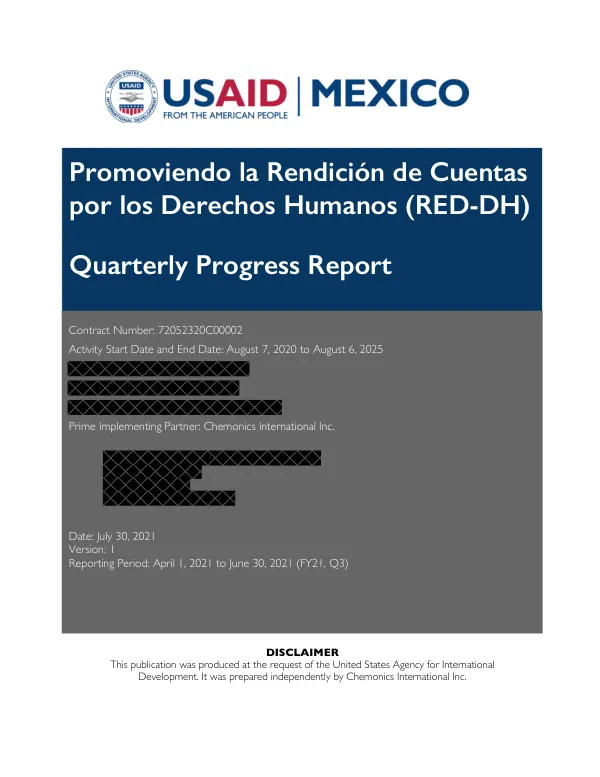
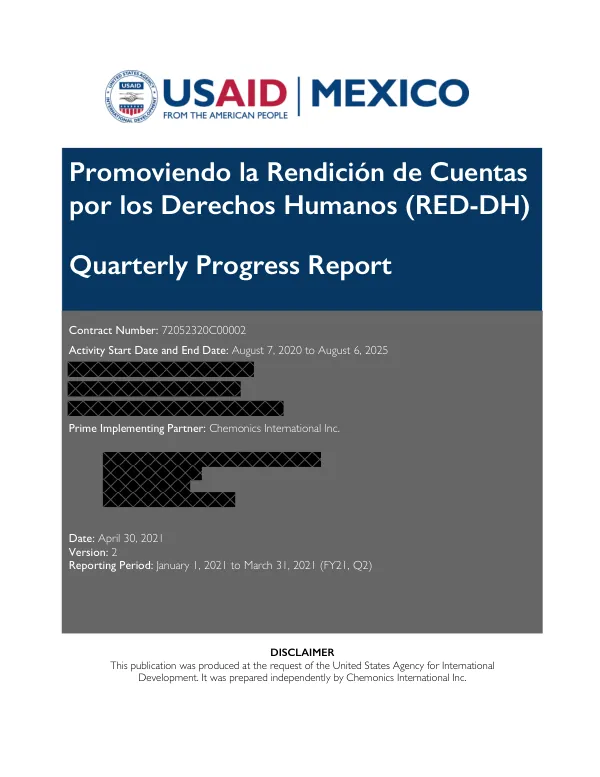
Y1 Q2 Quarterly Progress Report RED-DH
The Government of Mexico (GOM) presented the 2020 "Report on the Search and Identification of Disappeared Persons" in January 2021.
2021 · 16 pages
Sign in to readA free account is required to download.
Abstract
The report found that from 1964 to December 2020, 82,647 people were reported as missing or disappeared in Mexico. Jalisco, Sonora, and Veracruz, three of the five priority states for the Promoviendo la Rendición de Cuentas por los Derechos Humanos (RED-DH) activity, are among the top ten states with the most missing or disappeared persons reported from 2018 to date. Jalisco ranks first, accounting for 22.62% of disappearances, while Sonora and Veracruz rank third and ninth, respectively. The Unified Search Protocol came into effect on January 6th to guide and regulate the search efforts of relevant authorities across Mexico. The National Search Commission (CNB) published specific guidelines for granting subsidies to the states through their Local Search Commissions, amounting to 28.5 million USD, for equipment and training, strengthening and consolidating substantive search processes, implementing the Unified Search Protocol, and identifying actions that prioritize building, adapting, or equipping facilities for the temporary protection of bodies or human remains. Institutional changes occurred in January and March 2021. Andrés Vázquez, the Acting Director from the Office of the Executive Commission for Attention to Victims (CEAV), resigned after six months in the post. The members of the short list of three candidates seeking to become the head of the Executive Commission for Attention to Victims (CEAV) appeared before the joint commissions of the Interior and Human Rights, presenting their respective work plans in the event of being appointed to the position. The selection process continues in the Senate. Proposed reforms to the Organic Law of the General Prosecutor's Office (FGR) were discussed in January 2021. A public communication was issued to urge the Senate to guarantee the participation of families in the discussions of the reforms, and the State Search Commissions released a statement against the proposed changes. The Senate approved the reform with an addendum that kept the FGR with active participation in the National System. The Senate then sent the package of reforms to the House of Representatives for a new discussion, which is still pending. The Senate approved the 13 new honorary members of the Second National Search Citizen Council of the National Search System on March 11th. The Council acts as an independent citizen oversight body of the National Search System, comprised of five relatives of disappeared persons, three human rights specialists, one forensic expert, and four representatives from civil society organizations. Their role will be to assess the implementation status of the General Law, provide recommendations to government agencies in charge of such, and liaise with Search Commissions, civil society, and Local Citizen Councils to coordinate specific actions that will lead to more diligent efforts in the search, location, and identification of disappeared persons. The selection process for the Citizen Council for the General Prosecutor's Office (FGR) continues as part of the FGR's Organic Law. The Council will act as a specialized consultative body, of an honorary nature, whose functions include providing opinions, monitoring, and issuing public recommendations on the content and implementation of the FGR's Criminal Prosecution Plan, and annual programs.
Related documents