FIELD MEDICAL FOUNDATION
Yemen Communities Stronger Together (YCST) Baseline Study
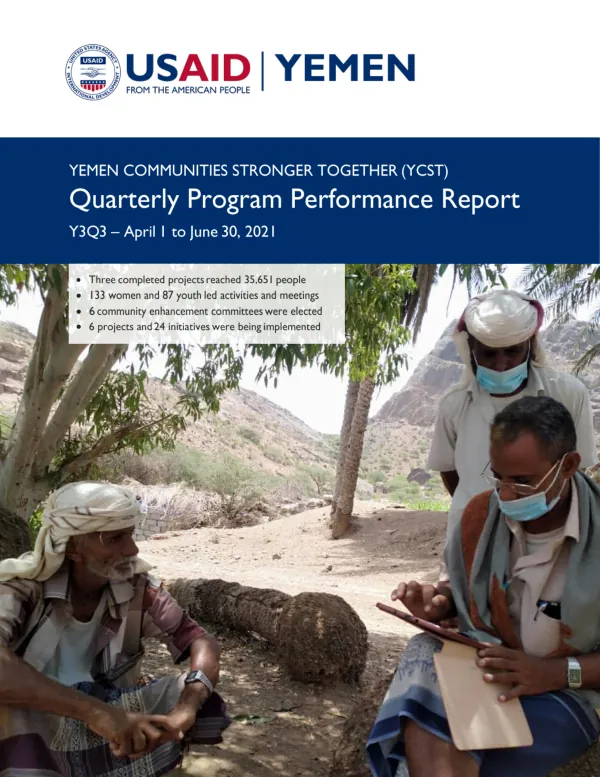
The Yemen Communities Stronger Together (YCST) programme is a three-year initiative funded by USAID and implemented by Global Communities in seven governorates in Yemen.
2019 · 74 pages
Sign in to readA free account is required to download.
Abstract
The programme aims to support local-level initiatives that mitigate conflict, strengthen social cohesion, promote the peaceful resolution of differences, and capitalize on stabilization opportunities in Yemen. To achieve this, YCST pursues four objectives: engaging communities in an inclusive approach to identify and implement service delivery and conflict mitigation projects, building the capacity of formal and informal local leaders, organizations, and networks to serve as neutral arbitrators and peace builders, piloting stabilization approaches to support local legitimate authorities, and carrying out regular and action-oriented learning and contextual analysis. The conflict in Yemen has exacerbated the needs of an already vulnerable population, with an estimated 80% of the population requiring some form of humanitarian assistance. The UN is targeting an estimated 13.6 million people in need of urgent humanitarian assistance, particularly in health, water, food, and protection. Global Communities has been working in Yemen since 2004, helping to empower young people and improve the educational system, as well as build the capacity of media and civil society to address and engage the public around social issues related to the rights of women and children. A Baseline Study was conducted to obtain reliable data on the Global Communities Social Capital Index (SCI), perceptions of current levels of community security, existing informal and formal resources to deal with conflict/insecurity, and the drivers of this conflict in targeted communities in the Abyan, Aden, and Lahj governorates of Yemen. The study used a mixed-methods approach, triangulating data from Household Surveys, Focus Group Discussions, and Key Informant Interviews, as well as drawing on secondary literature where appropriate. The study found marked differences between communities in measures of Social Capital, identifying specific weaknesses in specific communities. Priority communities for strengthening Social Capital include Khanfir-Juan (Abyan), and the Al-Sharqia and Al-Gharbia neighbourhoods. In these communities, levels of participation and trust are particularly low, though detailed findings from all communities give important information for informing programming and explaining insecurity. The report finds a severe disconnect between formal institutions of power (the state, local authorities, security services, judiciary) and most of the communities they serve. This disconnect is underpinned by a lack of trust, communication, and inclusion, as well as the competing legitimacies of informal actors and power bases such as tribal elders and Sheikhs. YCST programming must find a way to confront this problem if it aims to improve social cohesion, resilience, and the capacity of communities to confront conflict and instability. Conflict and instability take different forms in different communities, though violence against women, clashes between tribes and communities, banditry, robbery, and kidnapping are concerns alongside political and military conflict. There is substantial room for NGO work across targeted communities, with protection, health, WASH, food security, and nutrition programming being clearly vital. Recommendations include livelihoods programming, efforts to integrate informal and formal decision making to promote inclusivity and the rule of law, education awareness campaigns, action on violence against women, and programmes to build trust and networks between members of the communities. The success of any programming will be crucially dependent on equitable, well-informed, and inclusive distribution, which avoids corruption, nepotism, and empowering negative actors. This requires extensive engagement with all stakeholders across communities and direct, effective feedback mechanisms.