ARIZONA STATE UNIVERSITY
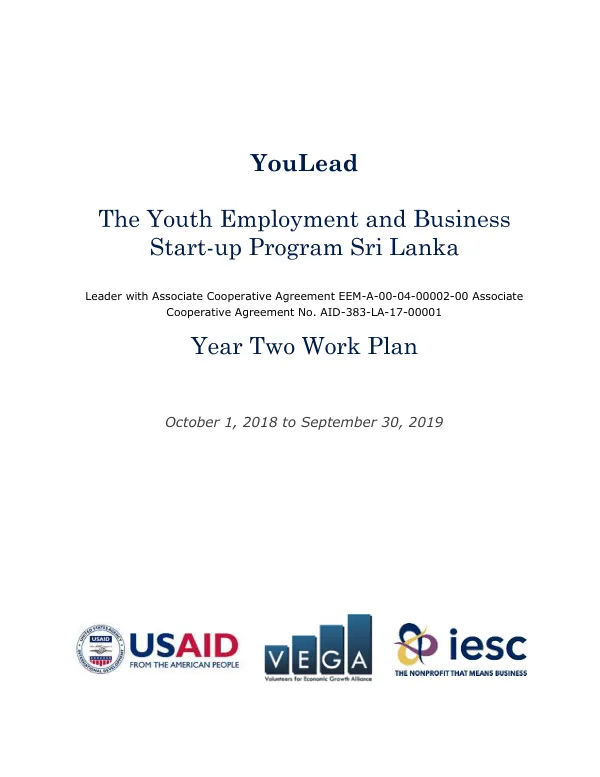
YouLead Year Two Work Plan
The Sri Lanka Youth Employment and Business Start-up Program (YouLead) is a project implemented by the Volunteers for Economic Growth Alliance (VEGA) and the International Executive Service Corps (IESC) under the Cooperative Agreement No.
2018 · 59 pages
Sign in to readA free account is required to download.
Abstract
EEM-A-00-04-00002-00, Associate Cooperative Agreement No. AID-383-LA-17-00001. The project aims to support USAID's Development objective of more inclusive economic opportunities and growth. The YouLead project focuses on increasing youth employability skills in targeted sectors, improving the quality, relevance, and delivery of Technical Vocational Education and Training (TVET), and increasing prospects for successful self-employment. The project's core activities are designed to leave behind institutional level capacity that will align public and private sector incentives, generate greater investment, and improve workforce competitiveness. In year one, the project focused on laying a foundation to build on to accelerate implementation and deepen impact. In year two, the project will focus on activities that contribute most effectively and directly to targets and development impact. The project will continue to focus on interventions in the tourism and construction industries, while working with ICT on an as-needed basis. The project has selected construction, tourism, and information and communications technology (ICT) as the primary focus industries. Construction and tourism offer the most near-term employment opportunities, while healthcare is a potentially high-growth sector in the future. However, job growth for youth in the healthcare sector without a university degree has not materialized according to recent market data analysis. The project will engage on a case-by-case basis wherever there is an opportunity to leverage the resources and commitment of other stakeholders to accelerate or expand the achievement of core project objectives. YouLead will also focus its year two activities on the 12 districts that encompass a combination of the 10 districts with the highest youth unemployment and the ten districts with the highest female youth unemployment. The project's technical approach includes train-the-trainer (ToT) interventions, greater youth engagement and outreach, and finding ways to encourage more direct engagement from the private sector in the way that young women and men are recruited, trained, and developed for the careers the Sri Lankan economy is creating or will create in the near future. The project's priority regions are the 12 districts that encompass a combination of the 10 districts with the highest youth unemployment and the ten districts with the highest female youth unemployment. The project's priority industries are construction, tourism, and ICT, with healthcare and retail trade as secondary priorities. The project's implementation plan for year two includes a range of activities, including training programs, infrastructure development, and market linkage facilitation. The project will also engage with local stakeholders, including the private sector, to leverage resources and commitment to accelerate or expand the achievement of core project objectives. The project's monitoring and evaluation plan includes a range of indicators, including youth employment rates, TVET enrollment, and business start-up rates. The project will also conduct regular assessments and evaluations to ensure that the project is meeting its objectives and making progress towards its targets. The project's budget for year two is $X, which will be used to support a range of activities, including training programs, infrastructure development, and market linkage facilitation. The project will also engage with local stakeholders, including the private sector, to leverage resources and commitment to accelerate or expand the achievement of core project objectives. The project's timeline for year two includes a range of milestones, including the completion of training programs, the establishment of new infrastructure, and the facilitation of market linkages. The project will also conduct regular assessments and evaluations to ensure that the project is meeting its objectives and making progress towards its targets. The project's sustainability plan includes a range of activities, including the development of institutional capacity, the establishment of partnerships with local stakeholders, and the transfer of knowledge and skills to local partners. The project will also engage with local stakeholders, including the private sector, to leverage resources and commitment to accelerate or expand the achievement of core project objectives.