USAID DEC
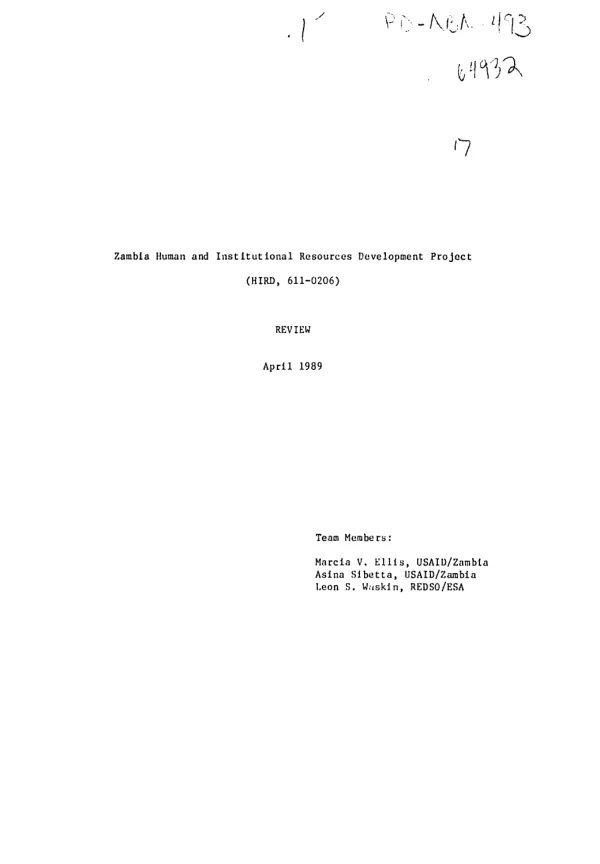
Zambia human and institutional resources development project (HIRD, 611-0206) : review
Sign inUSAID. MISSION TO ZAMBIA
Zambia human and institutional resources development project (HIRD, 611-0206) : review
After 4 years of delays, false starts, and controversy over the management and role of the Human and Institutional Resources Development Project (HIRD), USAID/Zambia, and the Government of the Republic of Zambia (GRZ) reached an agreement in 6/88 that has enabled project implementation to proceed at or close to its intended pace.
1989
Sign in to readA free account is required to download.
Abstract
More progress has been made in the 10 months following that agreement than was reallzed in the previous 4 years. An effective management structure is now in place, the large majority of participants are being trained in "critical shortage skill areas" as identified by the Project Paper, the GRZ and USAID are working harmoniously together on the project, and all returned participants with whom the review team spoke expressed their satisfaction with the quality and utility of the training they received. All involved are to be commended for having made so dramatic a recovery from so difficult a beginning. Nonetheless, some significant problems remain. The basic project documents -- the Project Paper, the Project Authorization, and the Project Grant Agreement -- have never been amended to reflect the various changes approved by USAID and the GRZ. In particular, the level of TA described in those documents is well out of date, and the output targets for long-term, short-term, and in-country training have been rendered unrealistic by the circumstances described above. More substantively, HIRD is not moving toward two key End of Project Status indicators: it is not providing training to parastatal and private sector employees, nor is it augmenting the capacity of indigenous Zambian training institutions. Further, the management structure for the in-country training program seems in immediate need of revision. To correct these deficiencies and smooth project management and implementation, this review team recommends that USAID and the GRZ take, among other actions, the following major steps. (1) Draft a Project Paper Supplement and Project Authorization Amendment and submit these to the Regional Legal Advisor for review. The RLA will then assist the Mission in drawing up a Grant Agreement Amendment. (2) Establish formal, written criteria for the selection of tralnees from the parastatal and private sectors and expand efforts to provide training to employees from these sectors. (3) Conduct at least two in-country training seminars through established Zambian training institutions. (4) Direct the prime TA contractor to assume direct responsibility for in-country training. (5) Take steps to ease the transition back to Zambian life for returned participants. The review team believes that these measures will help HIRD continue, and expand upon, the successes achieved since June 1988. (Author abstract)