Global Waters
Sustaining Latrine Coverage and Use: A Study of Community-Led Total Sanitation Programs in Northern Ghana
Sign inGLOBAL WATERS
Sustaining Latrine Coverage and Use: A Study of Community-Led Total Sanitation Programs in Northern Ghana
Prior studies have identified several aspects of Community-led Total Sanitation (CLTS) program implementation as crucial to both achieve and sustain open defecation free (ODF) communities: (i) the involvement of community leaders, (ii) intensity and duration of follow-up, and (iii) support to poor households, including financial support (Crocker et al., 2016; Tiwari et al., 2017; USAID, 2018; Venkataramanan et al., 2018).
2021
Sign in to readA free account is required to download.
Abstract
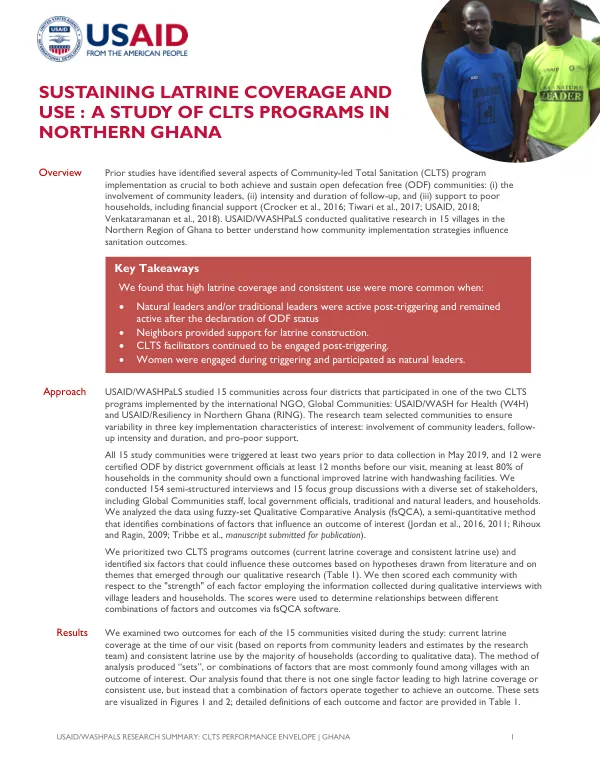
USAID/WASHPaLS conducted qualitative research in 15 villages in the Northern Region of Ghana to better understand how community implementation strategies influence sanitation outcomes. Key Takeaways: We found that high latrine coverage and consistent use were more common when: Natural leaders and/or traditional leaders were active post-triggering and remained active after the declaration of ODF status Neighbors provided support for latrine construction. CLTS facilitators continued to be engaged post-triggering. Women were engaged during triggering and participated as natural leaders.
Connected topics
Related documents