USAID Advancing Nutrition
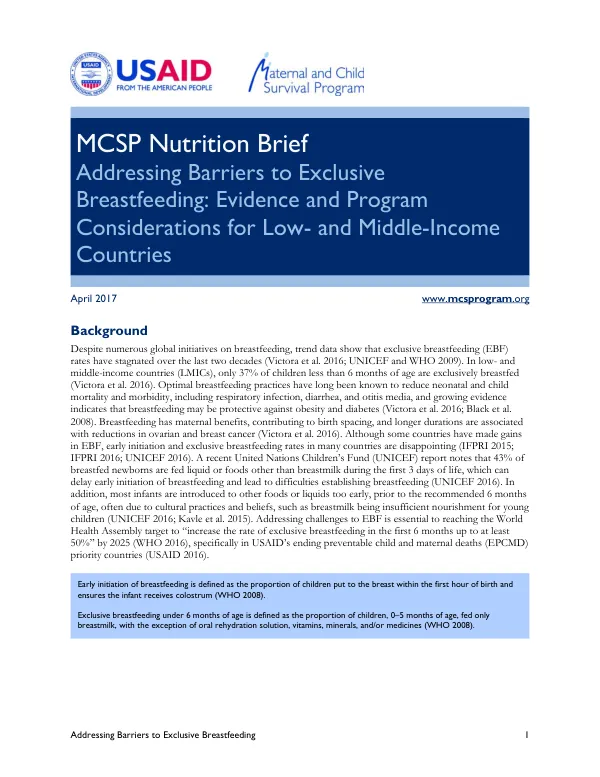
MCSP Nutrition Brief: Addressing Barriers to Exclusive Breastfeeding
Sign inMCSP
MCSP Nutrition Brief: Addressing Barriers to Exclusive Breastfeeding
This document is a nutrition brief that addresses the barriers to exclusive breastfeeding in low- and middle-income countries.
Maternal and Child Survival Program · 2017
Sign in to readA free account is required to download.
Abstract
The brief highlights the importance of exclusive breastfeeding, citing evidence that it reduces neonatal and child mortality and morbidity, and has maternal benefits. Despite global initiatives, exclusive breastfeeding rates have stagnated over the last two decades, with only 37% of children under six months of age being exclusively breastfed in low- and middle-income countries. The brief identifies three key barriers to exclusive breastfeeding: prelacteal feeding, delayed initiation of breastfeeding, and early introduction of foods and liquids. It also highlights maternal barriers to exclusive breastfeeding, including lack of or late attendance at antenatal care, poor knowledge of exclusive breastfeeding, maternal health and attitudes, and lack of intention to practice exclusive breastfeeding. Additionally, it identifies barriers to initiating and maintaining exclusive breastfeeding within the first day of life, including deliveries outside of facilities, delivery by cesarean section, and delayed initiation of breastfeeding. The brief also discusses major barriers to continuing to exclusively breastfeed throughout the first six months of life, including lack of maternal employment protections, perceptions of poor infant health, perceptions of insufficient breastmilk, perceived inadequate maternal nutrition, breastfeeding problems, and lack of counseling on breastfeeding.