USAID
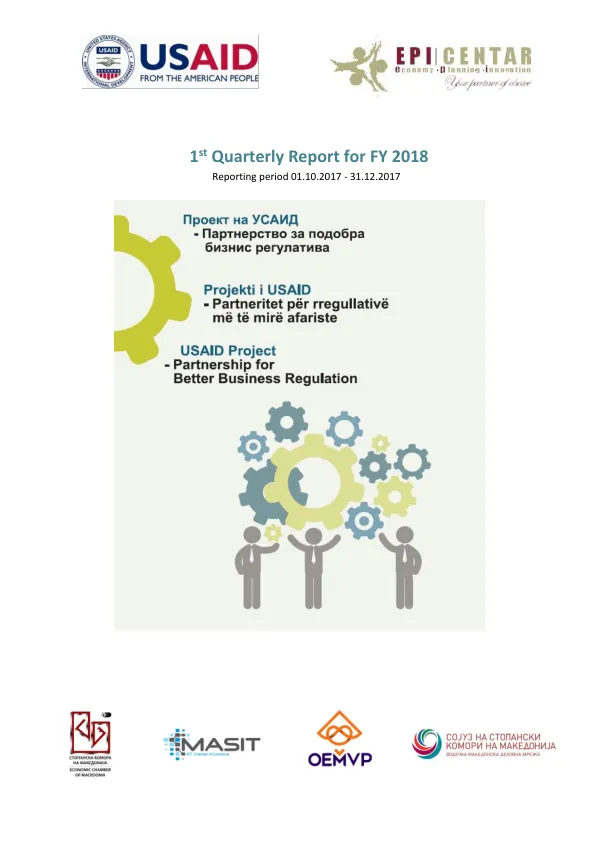
1st Quarterly Report for FY 2018
The Capacity Building of SMEs for Improved Legal Compliance activity in Macedonia is a complex initiative that includes several sub-activities aimed at providing direct assistance to small and medium enterprises (SMEs) in terms of legal compliance.
2018 · 31 pages
Sign in to readA free account is required to download.
Abstract
The activity is part of the overall project, which has a main task of assessing the business environment in Macedonia. During the first quarter of FY 2018, the project finalized the Second Assessment Report on the business environment in Macedonia. The report was developed in cooperation with the USAID Project - Modernizing Inspection Authorities, which engaged Jasminka Varnalieva as an external expert consultant responsible for analysis and synthesis of the findings. The assessment report provided a comparative analysis of the survey results collected during the first and second surveying cycles, resulting in a summarized illustration of the opinion related to the business environment in Macedonia. The report highlighted several key findings, including the fact that the surveyed companies have been visited by inspections on average 11 times in the last five years, with micro companies having the lowest number of inspections. The average number of inspections varies significantly across different sectors, with agriculture and tourism being the two sectors with the highest number of inspection visits. The most frequent inspections were conducted by the Public Revenue Office (PRO) and Customs, while the State Inspectorate for Construction and Urbanism had the lowest frequency of inspections. The survey also found that 65% of companies have not experienced delays in getting licenses, with ICT and textile sector companies experiencing delays in less than 10% of cases. However, agriculture and tourism sector companies experienced delays in almost 50% of cases. After completing the inspection audit, majority of companies did not get any sanction, with warning being issued to 24% of companies and fine to 18%. The survey also highlighted the need for additional education to stay in compliance with legal regulations, with only 12% of companies receiving invitations for education from inspection officers during inspection audits. The top training required by the majority of companies is in the area of finance and accounting, including tax and customs, while the second highest priority is training in labor regulations. In terms of info sessions, the project legal advisor in collaboration with EPI CENTAR International and the Chamber representatives discussed the topics for the info sessions. However, the beginning of FY 2018 brought significant changes in terms of activity planning and development, with the newly established Government affecting the activity planning and development. The project also organized voucher schemes to provide direct expert support to SMEs, with more than 2,500 farmers receiving training in sustainable agriculture techniques during the first year.