MACEDONIAN MINISTRY OF AGRICULTURE, FORESTRY AND WATER ECONOMY
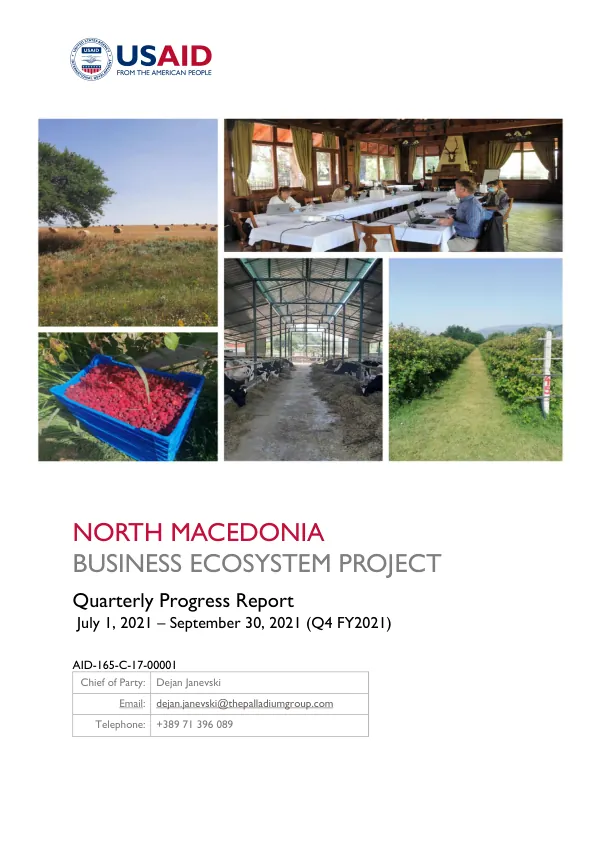
USAID Business Ecosystem Project Quarterly Progress Report (Jul 1 – Sep 30, 2021)
The Business Ecosystem Project (BEP) in North Macedonia is a four-year economic development project implemented by Palladium, with the goal of transforming the competitiveness of micro, small, and medium enterprises (MSMEs) in the country.
2021 · 36 pages
Sign in to readA free account is required to download.
Abstract
The project aims to strengthen business services, finance, and market linkages to catalyze a significant increase in MSME growth, productivity, and employment. BEP has three overarching and interlinked objectives: (1) Improved Business Support Organization (BSO) services to MSMEs, (2) Improved access to sources of financing for MSMEs, and (3) Increasing private sector engagement through lead firms investing in the development of supply chains and labor forces. The project will achieve these objectives through a mix of grants and technical assistance, as well as collaboration with the private and public sectors. During the past three years, BEP has made impressive strides, surpassing several indicator targets while remaining flexible and responsive to the changing needs of the project. The project has implemented proof-of-concept activities with the private sector, developed insights to scale successful initiatives in targeted sectors, and deepened collaboration with both the private and public sectors. In the previous quarter, Objectives 1 and 2 were successfully finalized and closed, surpassing the appointed targets. Under Objective 1, BEP assisted 3,827 companies, resulting in 151 improved processes, 501 companies with reported new job openings, and a total of 3,840 new jobs generated. Additionally, BEP registered 388 new buyer linkages and 1,377 companies with increased income and sales, resulting in $78,600,120 growth in revenues. Under Objective 2, the Financial Facilitators (FFs) assisted a total of 1,041 MSMEs (including startups), 613 of which (58.89%) successfully accessed a total of $110,549,319. Of these, $81,929,466 was mobilized from financial institutions and $28,619,853 was self-financed. During this quarter, BEP received a project extension until December 2022 to continue the work of Objective 3. The project's work in this quarter focused on finalizing the planned activities for FY4 and laying the foundation for future initiatives through close collaboration with different stakeholders in the ecosystem. BEP provided technical support for identifying and addressing potential legal barriers in the implementation of a specific integrated supply chains development measure, and an external consultant was contracted to conduct a comprehensive gap analysis and assessment of the feasibility of existing national legal and policy frameworks related to implementing specified measures focused on supporting the development of different supply chains. BEP's integrated approach ensures that activities leverage the benefits to MSMEs from the interrelated nature of services, finance, and private sector engagement. For example, the ability of MSMEs to access finance depends not only on facilitating lenders to enter and invest in this market but also on access to complementary services by BSOs to prepare firms to receive financing. BSOs also play a critical role in helping MSMEs access finance, and links with lead firms provide MSMEs with market opportunities that stimulate a need for financing to expand and/or improve production or services to meet buyer requirements. The project's results are expected to generate 15 percent average annual growth rate for MSMEs, resulting in $81.5 million in MSME revenue growth, create 5,750 new jobs, provide access to alternative and traditional financing for 250 MSMEs, facilitate $100 million in financing (investment and credit) for MSMEs and startups, and leverage $10 million from lead firm and private sector partners in support of project activities.