DELOITTE INC.
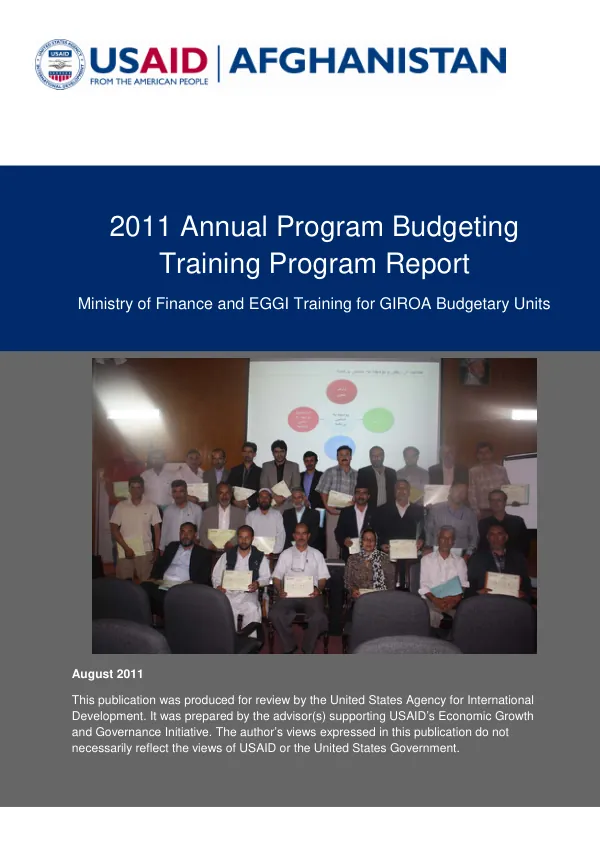
2011 Annual Program Budgeting Training Program Report
The Ministry of Finance (MoF) Budget Department, with USAID/EGGI support, delivered the annual program budgeting training program for all budgetary units in Afghanistan from July 2-25, 2011.
2011 · 33 pages
Sign in to readA free account is required to download.
Abstract
The training program was segmented into two levels: two-day workshops for experienced Ministries/Agencies and three-day workshops for less experienced Ministries/Agencies. Experienced Ministries/Agencies are those budgetary units with over two years of program budget implementation experience. The program for experienced Ministries covered six modules on topics including a program budgeting overview, budget submission forms, financial planning, budget execution, performance reporting, and future plans. The program for less experienced Ministries included eight modules with more comprehensive information provided on all aspects of program budgeting, including program budget structure, narrative, strategic objectives, outputs, and outcomes. The training sessions included breakout group work with practical, skill-building exercises to reinforce the concepts taught during the modules. A total of 365 participants, including 342 male and 23 female finance, planning, and administration officers, attended the training program. The participants evaluated the training event for four categories: Content Delivery, Trainers, Time Management, and Overall Satisfaction, on a scale of 1-5, with 1 indicating weak and 5 indicating excellent. The evaluation form also requested participants to comment on time management and overall satisfaction with the training event. Of the 365 participants, 228 (62%) completed evaluation forms. The general summary of the training program and the results of the evaluations are detailed in this report. Overall, the participants ranked the training program 4.3 out of 5. Key findings for each category include: Content Delivery, 95% of the total participants evaluated the practical sessions as good to excellent with an overall average rating of 4.4; Trainers, 98% of the total participants evaluated the trainers' delivery as good to excellent with an overall average rating of 4.7; Time Management, 85% of the participants considered the time management of the training sessions good to excellent with an overall average rating of 4.3; and Overall Satisfaction, 84% of participants rated their ability to use the information learned in the training for their work good to excellent, representing the lowest overall rating for any category rated at 4.1. Program budgeting is a framework for budgeting and accountability that assists budgetary units to better link their budgets with the Government's strategic objectives and policy priorities. For Afghanistan, these policies and priorities are set out in the Afghanistan National Development Strategy (ANDS) and in strategies of all line ministries. The program budgeting reform initiative requires the Government of the Islamic Republic of Afghanistan (GIRoA) and line ministries to focus on identifying programs, activities/projects, and outputs required to achieve their strategic objectives. This will ultimately improve their ability to assess progress towards achievement of these objectives. Program budgeting was first introduced in Afghanistan in 2006 to three pilot ministries. In 2007, the MoF working with the USAID/Capacity Development Project (CDP), expanded this reform initiative to seven government ministries. In December 2009, the MoF decided to roll out program budget reform to all 51 budgetary units (31 new budgetary units and 20 existing program budget pilots) for 2010 (SY-1390). In April 2010, USAID support for this initiative was transferred from the CDP project to the Economic Growth and Governance Initiative (EGGI) project. The Government reaffirmed its commitment to the implementation of program budget reform initiative through the July 2010 Kabul Conference process and the development of a Public Financial Management Roadmap presented to the International community on July 20, 2010.
Related documents