DELOITTE INC.
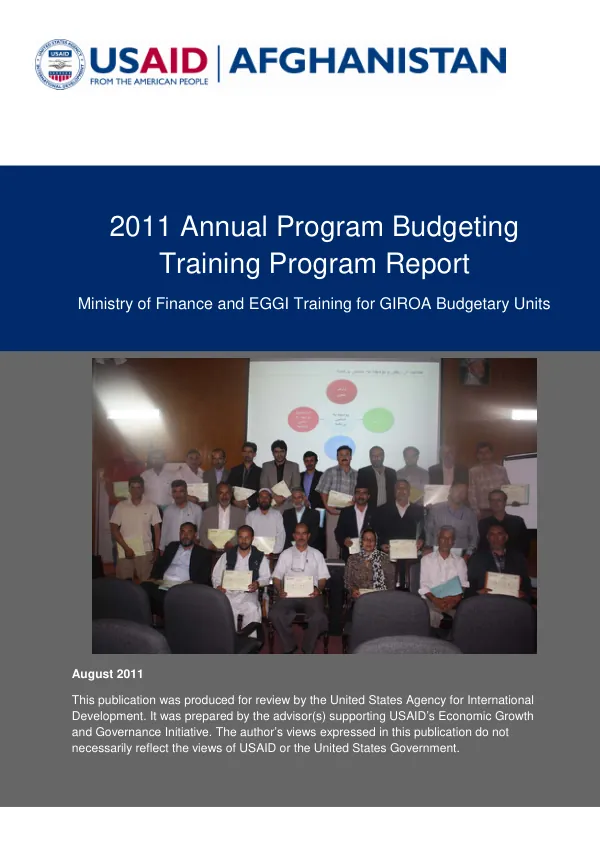
Report on GIROA Program Budget Training Program
The GIROA Program Budgeting Training Program was conducted in June and July 2010, with the aim of preparing all 51 budgetary units in Afghanistan for the full rollout of the program budgeting reform initiative.
2010 · 22 pages
Sign in to readA free account is required to download.
Abstract
The training was a key requirement for the successful implementation of the program budget reform, which is a major component of the Financial Roadmap presented to the international community on July 20, 2010, at the Kabul Conference. The training comprised seven, 2½ day seminars for employees of budgetary units new to the program budget reform, as well as six, one-day Program Budget refresher workshops for the 19 ministries currently within the program budgeting pilot. The seminars included an introduction to Program Budgeting, instructions on the development of the budgetary units' Program Structure, Strategic Objective, Program Objectives, Operational and Development Activities, Outcomes and Outputs, and instructions on how to fill out the Program Budget and Budget Execution forms. The training included practical sessions, with five out of the eight modules having group work. During this group work, government employees developed draft program structures, strategic objectives, program objectives, outcomes, and outputs for their respective budgetary units. The seminars were opened and closed by officials from the Ministry of Finance (MoF), and EGGI advisors worked with BIRU representatives to conduct the training. The evaluation of the training event was conducted on five major categories: Content Delivery, Preparation, Facilitator, Facility, and General Satisfaction. The evaluation was done on a scale of 1-5, with 1 indicating strongly disagree/poor and 5 indicating strongly agree/excellent. The results of the evaluation showed an overall ranking of 4.3 out of 5, with 84% of the participants considering the training to be good to excellent. The Program Budget reform is significant as it is a major component of the Financial Roadmap, and its implementation is crucial for the successful rollout of the program budgeting reform initiative. The training program was a major effort to prepare all 51 GIROA budgetary units for the full rollout of this program budgeting to all of Afghanistan's 51 budgetary units. The accomplishment is significant as last year only 19 budgetary units prepared program budgets. The Program Budgeting is an internationally recognized best practice framework for budgeting and accountability that assists budgetary units to better link their budgets with the Government's strategic objectives and policy priorities. In the case of Afghanistan, these policies and priorities are set out in the Afghanistan National Development Strategy (ANDS) and in individual line ministry strategies. The program budgeting reform initiative will require GIROA line ministries to focus on identifying outputs, activities, and projects required to achieve their strategic objectives, which will help improve their ability to assess progress towards achievement of these objectives. The Program Budgeting was first introduced in Afghanistan in 2006 to three pilot ministries. In 2007, the Ministry of Finance (MoF), working with the USAID Capacity Development Project (CDP), expanded this reform initiative to seven government ministries. In December 2009, the MoF decided to roll out the Program Budget Reform to all 51 budgetary units (314 new budgetary units and the 205 existing program budget pilots) for 2010 (1390 Afghan Budget Year).
Related documents