CENTER FOR EDUCATIONAL DEVELOPMENT
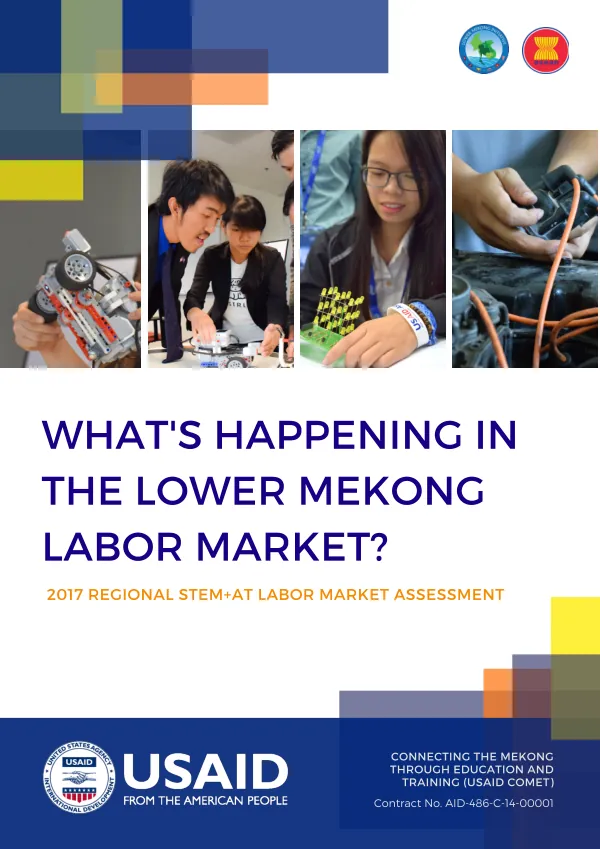
2017 Regional STEM+AT Labor Market Assessment Report
The Lower Mekong labor market is characterized by rapid economic growth, driven by industries such as natural resources, electronics, and mobile device products.
2017 · 58 pages
Sign in to readA free account is required to download.
Abstract
Key growth sectors shared among countries in the region include natural resources and higher-value sectors such as electronics, mobile device products, and manufacturing. Agriculture, which was previously identified as a growth sector, has experienced a slow-down relative to other industries. Innovation and creativity are expected to drive 21st Century economic growth in the region. Traditional companies are restructuring to promote innovation and creativity, while startups are actively collaborating with educational institutions to test new approaches and new technologies. The emergence of the startup sector is driving demand for employees who approach work with the attitude of a lifelong learner, are able to adapt quickly to new contexts, and are able to effectively manage internal team and external client relationships. Disruptive technologies, such as the Internet of Things (IOT), 3D printing, drones, robotics, and automation, and cloud computing, are likely to displace businesses and workers unable to keep pace. Innovative companies are pushing the envelope, and in some cases, pushing the limits on current policy. Changes at all levels, from policy to the business environment to education systems, will be under pressure to keep pace with the coming macroeconomic challenges. Employers in the region are seeking new hires with hybrid skills, which combine technical, entrepreneurial, and non-cognitive (soft) skills. These skills are increasingly in demand globally, and regional demand is expected to increase as the impact of disruptive technologies becomes more pronounced. Businesses across the region are seeking new hires who can direct their own learning of new technical and management skills, and who can effectively combine non-cognitive and technical skills to take on new challenges. Despite the growing demand for hybrid skills, female workers are under-represented in managerial and technical positions across the region. Biases against female workers persist across all industries surveyed. However, incorporating project-based learning may help to attract female students to technical STEM+AT fields and better position them for success in the emerging innovation economy. The USAID Connecting the Mekong through Education and Training (USAID COMET) Project aims to equip youth in the Lower Mekong sub-region with market-driven skills, promote gender-balanced employment in key sectors, and increase technology-based learning in vocational training and higher education classrooms. The project works with private sector partners to increase access to and use of technology in the classroom, and with local businesses to promote economic and employment growth in small communities and large cities. The project's data-driven approach includes an annual Regional STEM+AT Labor Market Assessment, which provides insights into the region's labor market trends and occupations incorporating STEM+AT. The assessment identifies specific technical and work readiness skill sets that need strengthening in the STEM+AT fields to increase the competitiveness of industries within the region. The project's focus on innovation, creativity, and hybrid skills is designed to address the skills mismatch identified by employers and promote economic growth in the region.