CENTER FOR EDUCATIONAL DEVELOPMENT
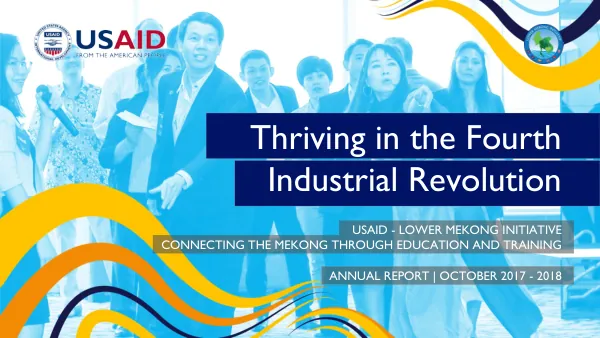
USAID-LMI COMET Year Four Annual Report 2018
The USAID-LMI COMET project aims to prepare a pipeline of skilled workers for the innovation economy in the Lower Mekong sub-region.
2018 · 81 pages
Sign in to readA free account is required to download.
Abstract
The project focuses on connecting youth, universities, vocational institutions, and industry partners to revamp Science, Technology, Engineering, and Math (STEM) education and better match market needs. This is achieved through the MekongSkills2Work (MS2W) Network, which consists of leadership institutions, often called Mekong Learning Centers (MLCs). Key skills required for the 4IR include creative problem-solving, analytical thinking, lifelong learning, communications, and teamwork. To develop these skills, the project promotes project-oriented and work-based learning, and encourages the development of innovation challenges or other activities structured around creative problem-solving. The USAID-LMI COMET project is working closely with institutions to build, broaden, or deepen collaboration with industry partners, creating more bridges to connect young, innovative, and capable learners with the innovation economy. In Year 4, the project has made significant achievements in deepening international partnerships. In collaboration with Cisco, the project promoted the launch of the Women Rock-IT series and other online resources for women in STEM. An all-female team of youth innovators from Mahidol University, Thailand, connected with Cisco through the MekongSkills2Work Network and visited the Cisco office in Bangkok to learn more about what it's like being a woman in STEM. Intel donated 850 Galileo Gen2 Smart boards for MLCs to use in IT classes and project-oriented learning activities like Innovation Challenges. The project has also partnered with Amazon Web Services to support cloud learning curricula and training at two MLCs. The project's focus on sustainability and scalability is evident in its efforts to institutionalize systems that foster innovation in teaching and learning. Key stakeholders are co-designing systems to ensure that innovation in teaching and learning is embedded, creating an approach that continuously fosters the skills youth need to thrive in the 4IR. The project's online community provides a platform for youth, universities, vocational institutions, and industry partners to connect and share best practices in STEM education. The MekongSkills2Work Network model has been successful in narrowing the skills gap in Southeast Asia. The network connects youth, universities, vocational institutions, and industry partners to revamp STEM education and better match market needs. The project's achievements in deepening international partnerships and promoting innovation in teaching and learning have set the stage for future success in preparing a pipeline of skilled workers for the innovation economy in the Lower Mekong sub-region.