CHEMONICS
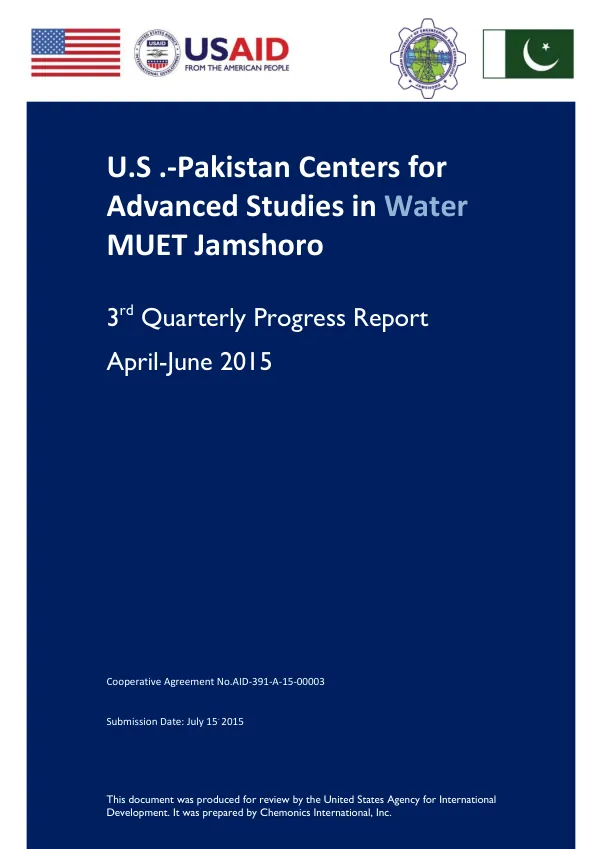
3rd Quarterly Progress Report: April – June 2015
The U.S.-Pakistan Centers for Advanced Studies in Water, located at the Mehran University of Engineering and Technology (MUET) in Jamshoro, Pakistan, has made significant progress in the third quarter of 2015.
2015 · 26 pages
Sign in to readA free account is required to download.
Abstract
The project, funded by the United States Agency for International Development (USAID), aims to enhance the capacity of MUET in water-related education, research, and training. Component 1: Governance of the CAS and the Higher Education has been instrumental in the project's success, ensuring that the project is executed in accordance with best project management practices and within the framework of MUET's governance processes. The Project Management Unit team, established in the first quarter, has been effective in planning and executing the project, and project staff, including faculty and non-faculty members, have been recruited and onboarded. The Board of Governors held its first meeting in the reporting quarter and provided policy guidance and approved terms and conditions. Component 2: Curriculum Reform has made significant progress, with the University of Utah team visiting faculty members at MUET and conducting detailed discussions and workshops on curriculum development. By the third quarter, courses were finalized, and dedicated faculty members were assigned to develop teaching methodologies, syllabi, and lesson plans. Component 3: High Quality Applied Research has been initiated, with the USPCAS-W awarding research grants to high-level and promising research projects. The award process has been devised, and a grant cycle plan will be followed on a biannual basis. The purpose of these grants is to promote water-related applied research that meets the needs of clients, including industry, community, and government. Component 4: The graduate and postgraduate training program has been established, offering four Master's Degree programs: Hydraulics, Irrigation, and Drainage (HID), Integrated Water Resources Management (IWRM), Environmental Engineering (ENVENG), and Water, Sanitation, and Health (WaSH). The WaSH Degree Program will start from Year 2 of the project, with admission and classes beginning on September 1, 2015. Component 5: Sustainability through industry/private sector links has been achieved through coordination with different stakeholders, industries, and private sectors for partnership and linkage creation. An executive seminar has been planned in partnership with the University of Utah on August 3, 2015, at Karachi, which will strengthen interaction with policy and decision-makers. The project has also made significant progress in hiring new full-time employees, including 12 faculty members (4 women) and 5 non-faculty members (2 women). The Organizational Capacity Assessment (OCA) tool was used to assess the capacity of MUET and USPCAS-W, identifying areas for improvement and development. Overall, the U.S.-Pakistan Centers for Advanced Studies in Water has made significant progress in the third quarter of 2015, achieving key milestones and making significant strides in its mission to enhance the capacity of MUET in water-related education, research, and training. The project has also made significant progress in implementing its Performance Management Plan, with performance against indicators and milestones being closely monitored. The project has achieved significant progress in Component 1: Governance of the CAS and the Higher Education, Component 2: Curriculum Reform, Component 3: High Quality Applied Research, Component 4: Graduate and Postgraduate Training, and Component 5: Sustainability through industry/private sector links. The project's progress has been closely monitored, and the project team has been effective in planning and executing the project. The project has made significant strides in its mission to enhance the capacity of MUET in water-related education, research, and training, and is well on track to achieve its objectives. The project's quarterly financial analysis has been conducted, and the project has been found to be financially stable. The project's success has been attributed to the effective management of the project team, the close monitoring of performance against indicators and milestones, and the effective implementation of the project's Performance Management Plan. The project has also made significant progress in its communication and outreach efforts, with the project team engaging with stakeholders, including industry, community, and government, to promote the project's objectives and achievements. The project's success has been recognized by stakeholders, and the project has been praised for its effective management and implementation.
Related documents