USAID DEC
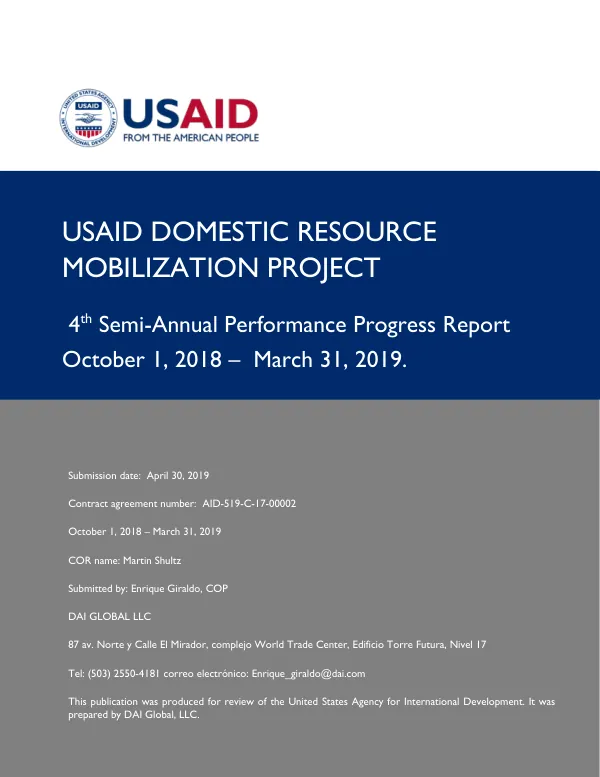
4th Semi-Annual Performance Progress Report: USAID El Salvador Domestic Resource Mobilization Project
Sign inDAI GLOBAL, LLC
4th Semi-Annual Performance Progress Report: USAID El Salvador Domestic Resource Mobilization Project
The Domestic Resource Mobilization Project in El Salvador aims to improve public financial management practices and generate additional revenue for the public sector.
2019 · 32 pages
Sign in to readA free account is required to download.
Abstract
The project, implemented by DAI Global, LLC, began on April 27, 2017, and is scheduled to conclude on April 26, 2022. The primary counterpart for these activities is the Ministry of Finance (MOF) of the Government of El Salvador (GOES). The project's goal is to strengthen financial management capabilities, leading to increased resource inflows and effective management of these resources by the national and local government. This, in turn, is expected to augment public investment, resulting in increased economic growth and employment generation. To achieve the expected results, the project has four main components: Budget Planning and Preparation Improved, Budget Execution Improved, Tax Policy and Administration Improved, and Transparency and Public-Private Dialogue on Fiscal Policy Strengthened. As of the reporting period, October 1, 2018, to March 31, 2019, the project has made progress in several areas. The ratio of tax collections as a percentage of GDP has increased by 0.35%, and public investment in the social sector as a percentage of total budget expenditures has increased to 44.09%. Additionally, public investment in the security and justice sector as a percentage of gross domestic product has increased to 3.25%. Component 1: Budget Planning and Preparation Improved has seen progress in several areas, including a 0.28% variance between actual and planned aggregate GOES revenues, and a 1.96% variance between actual and planned aggregate GOES expenditures. Furthermore, 0.00% of GOES entities are using a Result-Oriented Budget (ROB) approach, and 0.00% are planning and executing their budget based on a Medium-Term Fiscal Framework (MTFF) and Medium-Term Expenditure Framework (MTEF). Component 2: Budget Execution Improved has also made progress, with expenditure arrears as a percentage of total expenditures decreasing to 6.59% for the GOES and 6.50% for the municipal government. Additionally, 0.00% of GOES expenditures are going through the SAFI II system that are integrated with the Treasury Single Account (TSA). Overall, the project has made significant progress in improving public financial management practices and generating additional revenue for the public sector in El Salvador.