DAI GLOBAL, LLC
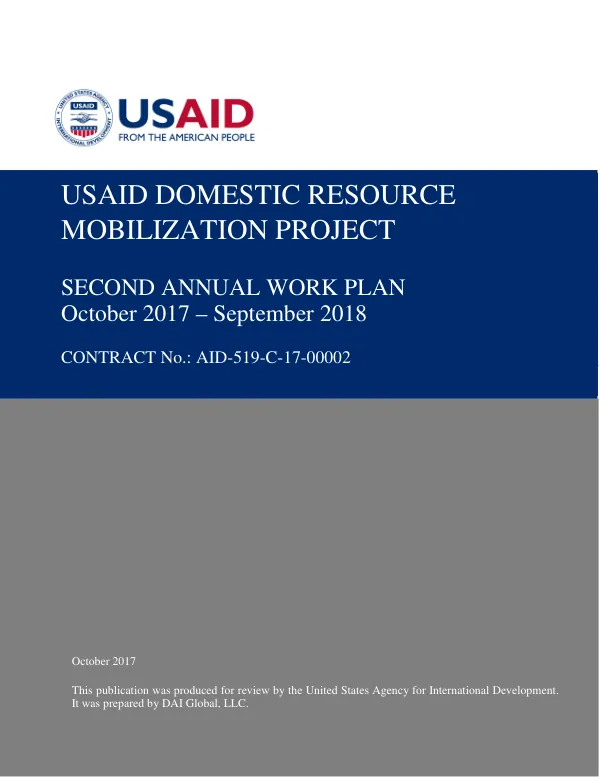
Second Annual Work Plan FY 2018
The Domestic Resource Mobilization Project in El Salvador aims to improve public financial management practices, increase domestic revenue mobilization, and generate additional revenue for the public sector.
2018 · 36 pages
Sign in to readA free account is required to download.
Abstract
The project is a five-year initiative funded by the United States Agency for International Development (USAID) and implemented by DAI Global, LLC. The project's goals are to contribute to the Government of El Salvador's (GOES) effort to achieve a tax revenue increase of 2% of Gross Domestic Product (GDP) over the baseline established at the end of 2017. The project is divided into four components: Budget Planning and Preparation Improved, Budget Execution Improved, Tax Policy and Administration Improved, and Transparency and Public-Private Dialogue on Fiscal Policy Strengthened. Component 1, Budget Planning and Preparation Improved, focuses on reviewing and improving the budget planning and preparation process, with the goal of implementing a result-oriented budget formulation. This component will work with the Directorate of Public Expenditure and Financial Management (DPEF), the Budget General Directorate (DGP), and the European Union (EU) to achieve this goal. Component 2, Budget Execution Improved, aims to improve the execution of the budget, with a focus on increasing transparency and accountability in public expenditure management. This component will work with the Ministry of Finance (MOF) to implement a system for monitoring and evaluating public expenditure, and to strengthen the capacity of the MOF to manage public finances. Component 3, Tax Policy and Administration Improved, focuses on improving the tax policy and administration system, with the goal of increasing tax revenue and improving tax compliance. This component will work with the MOF to review and improve the tax policy and administration system, and to implement a system for monitoring and evaluating tax revenue. Component 4, Transparency and Public-Private Dialogue on Fiscal Policy Strengthened, aims to strengthen transparency and public-private dialogue on fiscal policy, with the goal of improving fiscal transparency and accountability. This component will work with the MOF and other stakeholders to implement a system for monitoring and evaluating fiscal policy, and to strengthen the capacity of the MOF to engage in public-private dialogue on fiscal policy. The project's activities for FY 2018 are critical to maintaining continuity of previous USAID technical support provided to the MOF, starting to implement new reforms, and ensuring achievement and sustainability of the project's goals. The project's second annual work plan defines in detail how DAI has organized its work to implement the Domestic Resource Mobilization Project and achieve the expected results. The project's goals are comprised of several key objectives, including increasing tax revenue, improving public expenditure management, increasing fiscal transparency, and strengthening public-private dialogue on fiscal policy. The project's expected outcomes include a tax revenue increase of 2% of GDP, a result-oriented budget formulation, improved public expenditure management, increased fiscal transparency, and a strengthened public-private dialogue on fiscal policy. The project's activities will be implemented in collaboration with the MOF, the DPEF, the DGP, the EU, and other stakeholders. The project's success will depend on the effective implementation of its activities, the commitment of the MOF and other stakeholders, and the availability of resources and support. The project's budget for FY 2018 is $X, which will be used to implement the project's activities and achieve its expected outcomes. The project's budget will be managed by DAI, in collaboration with the MOF and other stakeholders. The project's monitoring and evaluation plan will be implemented to track progress towards the project's expected outcomes and to identify areas for improvement. The project's monitoring and evaluation plan will include regular reporting, data collection, and analysis, as well as a mid-term evaluation and a final evaluation. The project's sustainability plan will be implemented to ensure that the project's outcomes are sustained beyond the project's lifespan. The project's sustainability plan will include capacity building, institutional strengthening, and resource mobilization. Overall, the Domestic Resource Mobilization Project in El Salvador aims to improve public financial management practices, increase domestic revenue mobilization, and generate additional revenue for the public sector. The project's goals are to contribute to the GOES effort to achieve a tax revenue increase of 2% of GDP over the baseline established at the end of 2017, and to implement a result-oriented budget formulation, improve public expenditure management, increase fiscal transparency, and strengthen public-private dialogue on fiscal policy.