USAID DEC
52-Burkina Faso_OTI BFRP_Bi-weekly Report_Nov_2020
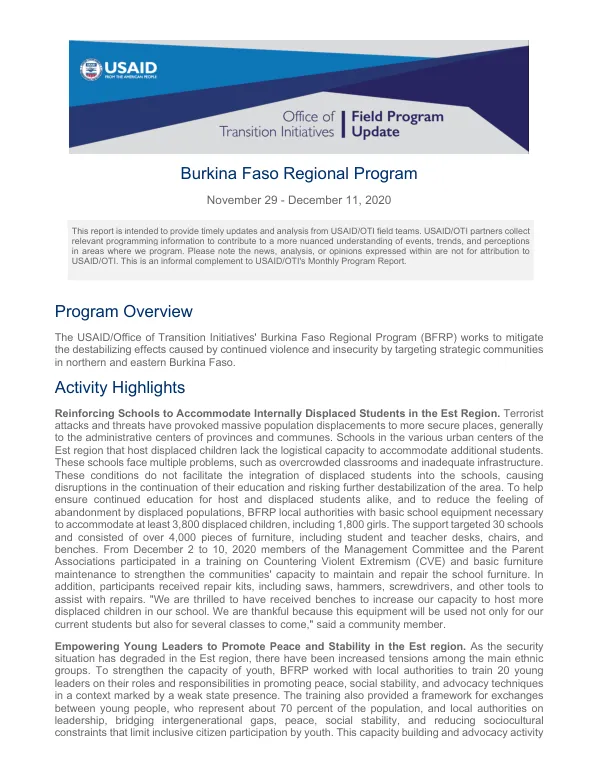
The Burkina Faso Regional Program, implemented by USAID/OTI, aims to mitigate the destabilizing effects of continued violence and insecurity in northern and eastern Burkina Faso.
2020 · 2 pages
Sign in to readA free account is required to download.
Abstract
The program targets strategic communities, focusing on areas with high population displacement due to terrorist attacks and threats. Reinforcing schools to accommodate internally displaced students in the Est region is a key activity of the program. Terrorist attacks and threats have led to massive population displacements, resulting in overcrowded classrooms and inadequate infrastructure in schools hosting displaced children. To address this issue, the program provided basic school equipment to 30 schools, including over 4,000 pieces of furniture, to accommodate at least 3,800 displaced children, including 1,800 girls. The support also included training for local authorities and parent associations on Countering Violent Extremism (CVE) and basic furniture maintenance. In addition to providing school equipment, the program empowered young leaders to promote peace and stability in the Est region. The training, which targeted 20 young leaders, focused on their roles and responsibilities in promoting peace, social stability, and advocacy techniques in a context marked by a weak state presence. The training also provided a framework for exchanges between young people and local authorities on leadership, bridging intergenerational gaps, peace, social stability, and reducing sociocultural constraints that limit inclusive citizen participation by youth. The program has achieved significant results, with 178 activities implemented and 387,700 program beneficiaries. The program has also partnered with 114 organizations to date. The provision of school equipment and training for young leaders has helped to strengthen the capacity of local communities to maintain and repair school furniture, as well as promote peace and stability in the Est region. The program's focus on empowering young leaders is critical in promoting peace and stability in the Est region, where increased tensions among main ethnic groups have been reported. By training 20 young leaders on their roles and responsibilities in promoting peace, social stability, and advocacy techniques, the program aims to trigger the youth's engagement in finding lasting solutions for stability within the current social and security contexts. The program's efforts to reinforce schools and empower young leaders demonstrate its commitment to mitigating the destabilizing effects of continued violence and insecurity in northern and eastern Burkina Faso.
Related documents