USAID DEC
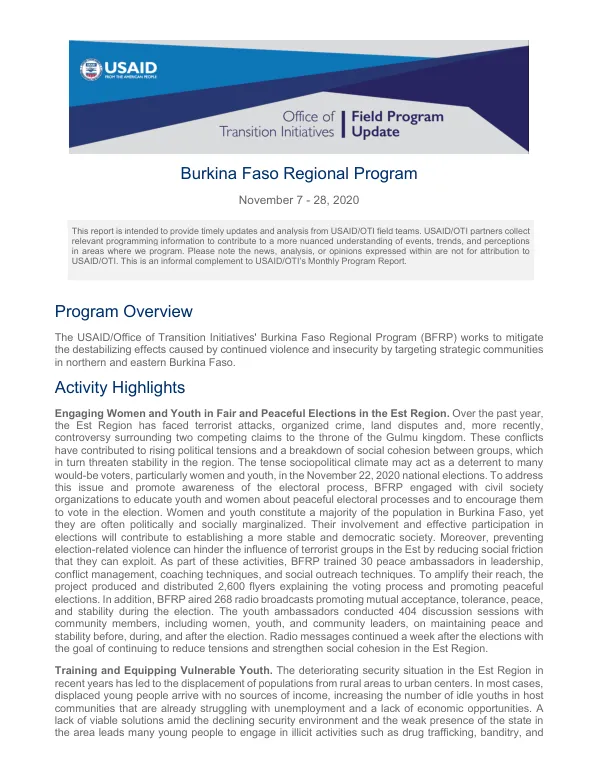
Burkina Faso Regional Program Bi-weekly Report November 2020
The Burkina Faso Regional Program, implemented by USAID/OTI, aims to mitigate the destabilizing effects of continued violence and insecurity in northern and eastern Burkina Faso.
2020 · 2 pages
Sign in to readA free account is required to download.
Abstract
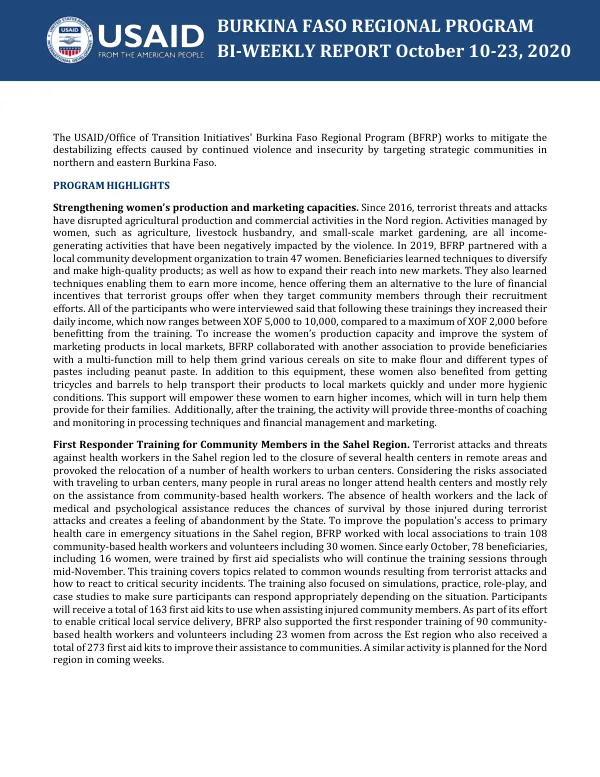
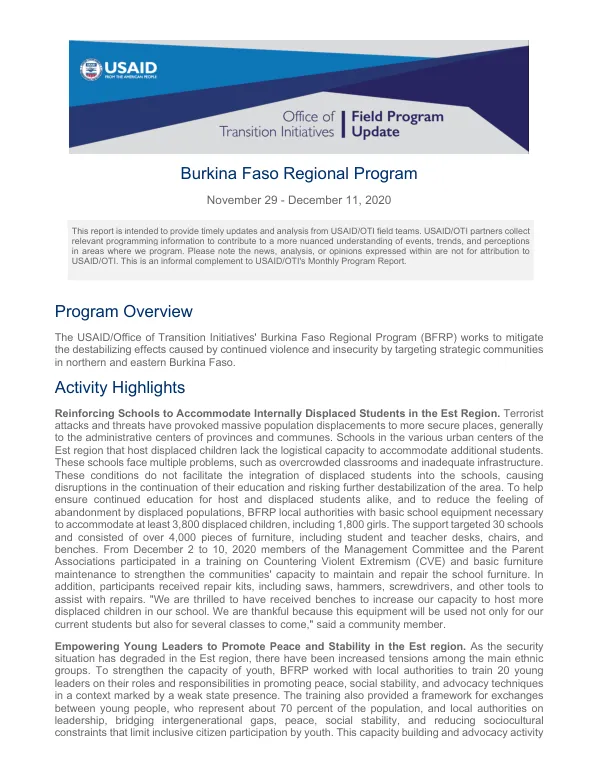
The program targets strategic communities in these regions, focusing on areas with high levels of terrorist activity, organized crime, and social unrest. In the Est Region, the program has been working to promote peaceful elections and encourage women and youth to participate in the electoral process. The region has faced significant challenges, including terrorist attacks, organized crime, and land disputes, which have contributed to rising political tensions and a breakdown of social cohesion. To address these issues, the program engaged with civil society organizations to educate youth and women about peaceful electoral processes and to encourage them to vote in the November 2020 national elections. As part of these activities, the program trained 30 peace ambassadors in leadership, conflict management, coaching techniques, and social outreach techniques. The peace ambassadors conducted 404 discussion sessions with community members, including women, youth, and community leaders, on maintaining peace and stability before, during, and after the election. The program also produced and distributed 2,600 flyers explaining the voting process and promoting peaceful elections, and aired 268 radio broadcasts promoting mutual acceptance, tolerance, peace, and stability during the election. In addition to promoting peaceful elections, the program has been working to equip vulnerable youth with alternative income sources. The deteriorating security situation in the Est Region has led to the displacement of populations from rural areas to urban centers, resulting in a large number of idle youths in host communities. To address this issue, the program supported a local organization in setting up accelerated vocational training for 50 unemployed and vulnerable youth. The beneficiaries were trained in various trades, including motorcycle mechanics, solar electricity repair, and weaving and dyeing cloth, and received equipment to help them work in their respective trades. The program has achieved significant results, with 176 activities implemented and 160,079 program beneficiaries. The program has also partnered with 115 organizations to date. The success of the program is evident in the testimonies of the beneficiaries, who have expressed gratitude for the opportunities provided to them. For example, one participant stated, "I can now make all kinds of fabrics with the material I received. Thanks to this activity, I am confident that I will be self-sufficient in the coming months, and I commit myself to train and coach other young girls to help my community."
Related documents