DAI
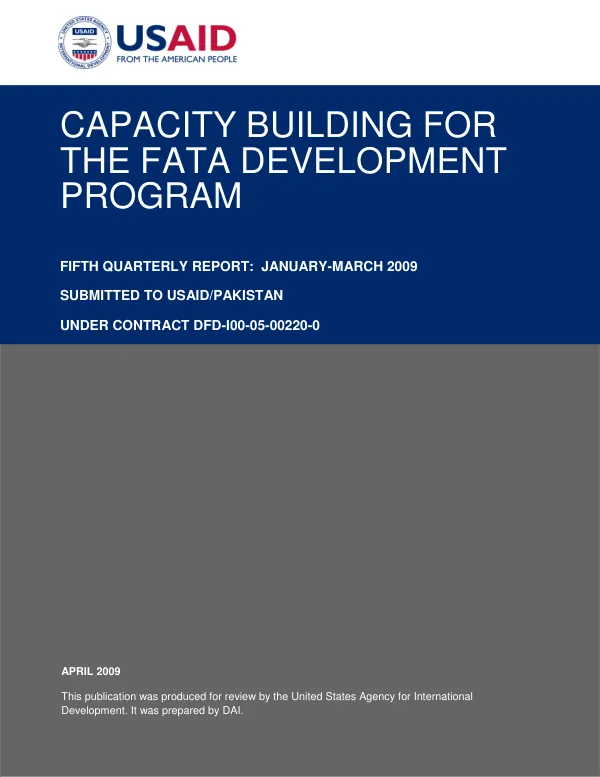
5th Quarterly Progress Report: FATA Capacity Building Program
The FATA Capacity Building Program is a capacity building initiative for the Federally Administered Tribal Areas (FATA) of Pakistan.
2009 · 32 pages
Sign in to readA free account is required to download.
Abstract
The program aims to operationalize FATA's sustainable development plans, improve the capacity of FATA public sector institutions, and enhance the capacity of civil society organizations. The program is implemented by the FATA Secretariat and the FATA Development Authority, in collaboration with the United States Agency for International Development (USAID). The program has made significant progress in the first quarter of 2009. In Component A, the program organized a ROZ Workshop in Islamabad, which aimed to deliberate issues related to the Revitalized Opportunities Zone (ROZ). The workshop report was developed and shared among key stakeholders. Additionally, the program drafted a proposal to create a "Special Economic Zone Cell" at the Sarhad Development Agency (SDA). In Component B, the program completed the first version of a GIS tracking system titled "Online GIS Enabled Database Interface for FATA USAID Projects." The program also organized four orientation training workshops for six selected FATA USAID projects, which aimed to brief participants about the objectives for developing the FATA USAID GIS system. In Component C, the program improved the capacity of FATA public sector institutions by developing a training calendar for the year 2009. During the reporting period, the program facilitated 16 training courses, training a total of 299 people from the FATA Secretariat. The trainings focused on building and strengthening project management, development planning, financial management, and information technology capabilities of staff. In Component D, the program improved the capacity of civil society organizations by revising and finalizing the "Strategy for CSOs Development." The program also processed twenty-nine grants and forwarded ten to the CTO for approval. Eighteen grants were approved during the reporting period. In Component E, the program improved coordination and integration of civilian and military activities by approving a concept paper, including a staff recruitment plan and an action plan. An external advisor for CMC and the CMC Coordinator at FATA Secretariat were engaged in the process of creating a recruitment and action plan. In Component F, the program developed a communications strategy, which aimed to facilitate and accelerate the return of Internally Displaced Persons (IDPs). The program facilitated a workshop to initiate a strategy on facilitating and accelerating the return of IDPs. A working group was formed to finalize a strategy paper and a reform matrix on interim strategy for IDPs was circulated among stakeholders and finally presented in the CMC meeting for approval. The program has made significant progress in the first quarter of 2009, and the achievements are expected to have a positive impact on the development of FATA.