FHI 360
A Brief Guide to the Method Choice Framework
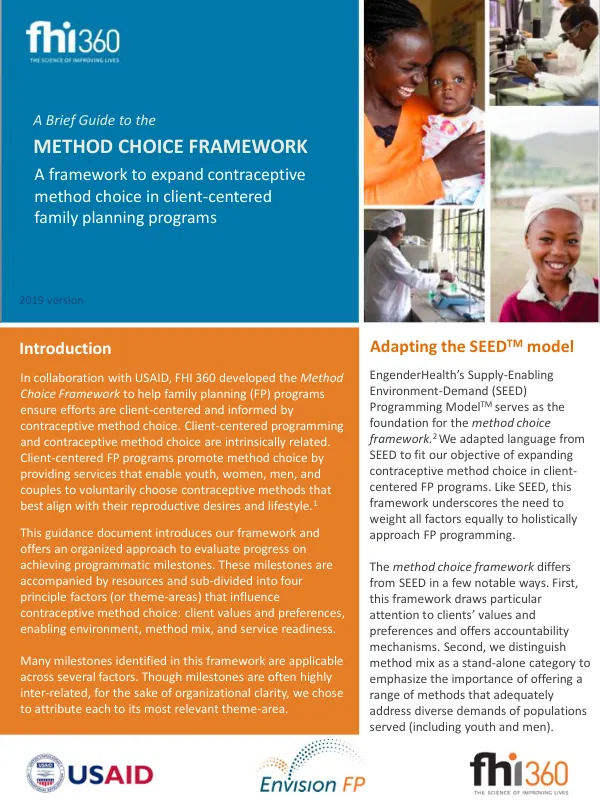
The Method Choice Framework is a framework designed to expand contraceptive method choice in client-centered family planning (FP) programs.
2019 · 11 pages
Sign in to readA free account is required to download.
Abstract
The framework is based on the SEED model, which emphasizes the need to weigh all factors equally to approach FP programming holistically. The Method Choice Framework differs from SEED in its focus on clients' values and preferences, offering accountability mechanisms, and emphasizing the importance of offering a range of methods that address diverse demands of the population served. Client-centered programming and contraceptive method choice are intrinsically related. Client-centered FP programs promote method choice by providing services that enable individuals to voluntarily choose contraceptive methods that best align with their reproductive desires and lifestyle. The framework introduces four principle factors that influence contraceptive method choice: client values and preferences, enabling environment, method mix, and service readiness. To ensure contraceptive method choice, programs must consider a variety of factors, including individual preferences, policies, and policies. The framework divides these factors into four major factors that influence contraceptive method choice. Raising awareness and increasing access to information about methods is an integral part of each component. Client values and preferences are essential to successfully integrating contraceptive method choice in FP programs. The client encompasses not only women but also youth and men. Client values and preferences inform strategies across facilitating an enabling environment, ensuring an adequate method mix, and strengthening service readiness. This theme underscores the need for informed method choice and voluntarism. To expand clients' knowledge and make informed decisions about their reproductive lives, programs should invest in efforts to expand clients' knowledge and participation in FP discussions. Programs should also provide unbiased information about contraceptive methods, regardless of age, sex, marital status, or number of children. A range of programs, including health education and gender programs, should build supportive social environments, empower clients, and foster skills to navigate conversations about contraceptive methods with providers and partners. Programs should also provide accurate, evidence-based information through various forms of communication, including peer-groups, advertising, digital technology, and mHealth. Community-level champions should be identified, trained, and supported to lead individual and group discussions on FP and facilitate community engagement. Programs should be in-tune to power dynamics in relationships and client relationships. The framework emphasizes the importance of informed method choice and voluntarism. To achieve this, programs should invest in efforts to expand clients' knowledge and participation in FP discussions. Programs should also provide unbiased information about contraceptive methods, regardless of age, sex, marital status, or number of children. The Method Choice Framework is a comprehensive approach to integrating contraceptive method choice in client-centered FP programs. Although the framework equally weighs all four factors influencing method choice, programs may prioritize certain factors due to resource limitations or feasibility concerns. The framework offers a total market approach to FP, harnessing resources across public, private, and private agencies to provide high-quality services and products. The framework is designed to be adaptable and can be applied in diverse country settings and programmatic contexts. The framework will be piloted in southern Africa, specifically in Namibia, Botswana, and eSwatin. The piloting phase will involve drawing upon tools referenced in the framework to address country-specific needs. The framework will be shared after the piloting phase to facilitate adaptations in additional countries. The framework provides a four-step approach to applying the framework: identifying stakeholders to engage in a total market approach, evaluating existing strengths and weaknesses, triaging priority areas and identifying feasible goals, and implementing evidence-based strategies to achieve goals. The framework offers a comprehensive approach to integrating contraceptive method choice in client-centered FP programs, emphasizing the importance of informed method choice and voluntarism.