NEW MEXICO STATE UNIVERSITY
A Comparative Analysis of Earth Observation Woody Canopy Cover Estimates for Africa
However, this document focuses on a comparative analysis of earth observation woody canopy cover estimates for Africa.
2022 · 2 pages
Sign in to readA free account is required to download.
Abstract
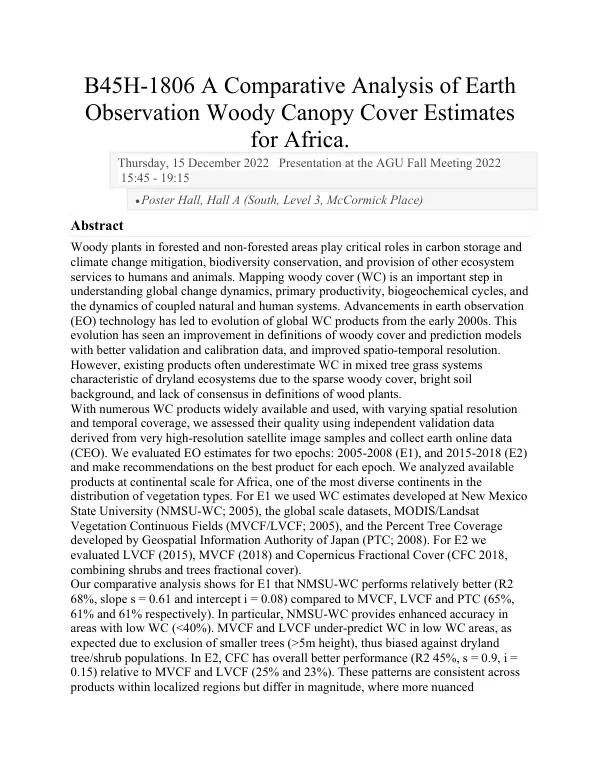
The analysis aims to evaluate the accuracy of various global woody cover products using independent validation data. The study focuses on two epochs: 2005-2008 (E1) and 2015-2018 (E2). For E1, the researchers evaluated four products: NMSU-WC, MVCF/LVCF, and PTC. The results show that NMSU-WC performs relatively better than the other products, with a correlation coefficient of 68% and a slope of 0.61. NMSU-WC provides enhanced accuracy in areas with low woody cover (<40%). In contrast, MVCF and LVCF under-predict woody cover in low WC areas, which is attributed to the exclusion of smaller trees (>5m height). For E2, the researchers evaluated three products: LVCF, MVCF, and CFC. The results show that CFC has overall better performance, with a correlation coefficient of 45% and a slope of 0.9. CFC performs better than MVCF and LVCF, which are modeled at a higher spatial resolution. The results indicate that analysis requiring continental Africa WC estimates for E1 should use NMSU-WC, while for E2, CFC is recommended. The study highlights the importance of accurate woody cover estimates for understanding global change dynamics, primary productivity, biogeochemical cycles, and the dynamics of coupled natural and human systems. The results of this study provide valuable insights for researchers and policymakers working on environmental conservation and climate change mitigation in Africa. The analysis of existing products shows that they often underestimate woody cover in mixed tree-grass systems characteristic of dryland ecosystems. The study highlights the need for more accurate and reliable woody cover products, especially in areas with low woody cover. The results of this study will contribute to the development of more accurate and reliable woody cover products, which will be essential for understanding the dynamics of coupled natural and human systems in Africa. The study highlights the importance of using high-resolution satellite images and independent validation data to assess the accuracy of woody cover products. The results of this study will provide valuable insights for researchers and policymakers working on environmental conservation and climate change mitigation in Africa.
Related documents