USAID DEC
Strengthening Impact Evaluation Quality in Africa through Partnerships: A Pathway to Sustainable Development
Sign inFRENCH AGRICULTURAL RESEARCH CENTER FOR INTERNATIONAL DEVELOPMENT
Strengthening Impact Evaluation Quality in Africa through Partnerships: A Pathway to Sustainable Development
Impact evaluation quality directly affects its use as a learning tool.
2010 · 1 pages
Sign in to readA free account is required to download.
Abstract
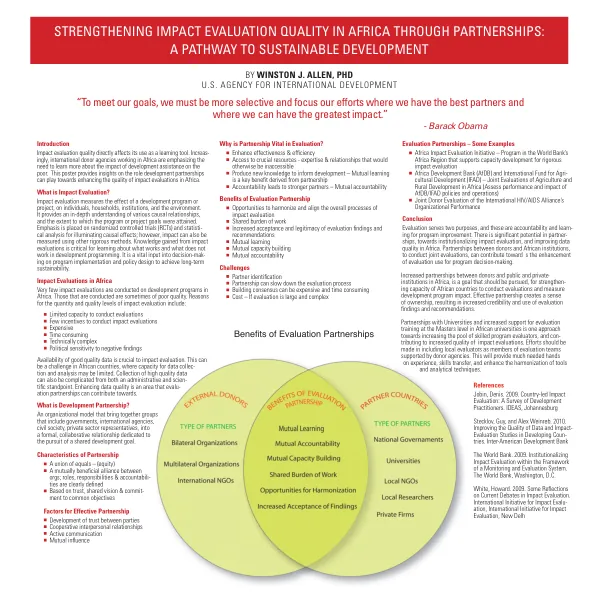
International donor agencies working in Africa are emphasizing the need to learn more about the impact of development assistance on the poor. This poster provides insights on the role development partnerships can play towards enhancing the quality of impact evaluations in Africa. Impact evaluation measures the effect of a development program or project on individuals, households, institutions, and the environment. It provides an in-depth understanding of various causal relationships and the extent to which the program or project goals were attained. Emphasis is placed on randomized controlled trials (RCTs) and statistical analysis for illuminating causal effects; however, impact can also be measured using other rigorous methods. Knowledge gained from impact evaluations is critical for learning about what works and what does not work in development programming. It is a vital input into decision-making on program implementation and policy design to achieve long-term sustainability. Very few impact evaluations are conducted on development programs in Africa. Those that are conducted are sometimes of poor quality. Reasons for the quantity and quality levels of impact evaluation include limited capacity to conduct evaluations, few incentives to conduct impact evaluations, high costs, time-consuming processes, technical complexity, and political sensitivity to negative findings. Availability of good quality data is crucial to impact evaluation, which can be a challenge in African countries where capacity for data collection and analysis may be limited. An organizational model that brings together groups such as governments, international agencies, civil society, and private sector representatives into a formal, collaborative relationship dedicated to the pursuit of a shared development goal is known as a development partnership. Characteristics of a partnership include a union of equals, a mutually beneficial alliance between organizations, clearly defined roles, responsibilities, and accountability, and a shared vision and commitment to common objectives. Factors for effective partnership include the development of trust between parties, cooperative interpersonal relationships, active communication, and mutual influence. Partnerships are vital in evaluation as they enhance effectiveness and efficiency, provide access to crucial resources, produce new knowledge to inform development, and lead to mutual accountability. Benefits of evaluation partnerships include opportunities to harmonize and align the overall processes of impact evaluation, a shared burden of work, increased acceptance and legitimacy of evaluation findings and recommendations, mutual learning, mutual capacity building, and mutual accountability. Challenges of partnerships include partner identification, the potential for partnerships to slow down the evaluation process, building consensus, and costs associated with large and complex evaluations. Examples of evaluation partnerships include the Africa Impact Evaluation Initiative, a program in the World Bank's Africa Region that supports capacity development for rigorous impact evaluation, and joint evaluations of agriculture and rural development in Africa conducted by the Africa Development Bank and the International Fund for Agricultural Development. Partnerships between donors and African institutions to conduct joint evaluations can contribute to the enhancement of evaluation use for program decision-making. Strengthening impact evaluation quality in Africa through partnerships is a pathway to sustainable development.
Related documents