USAID DEC
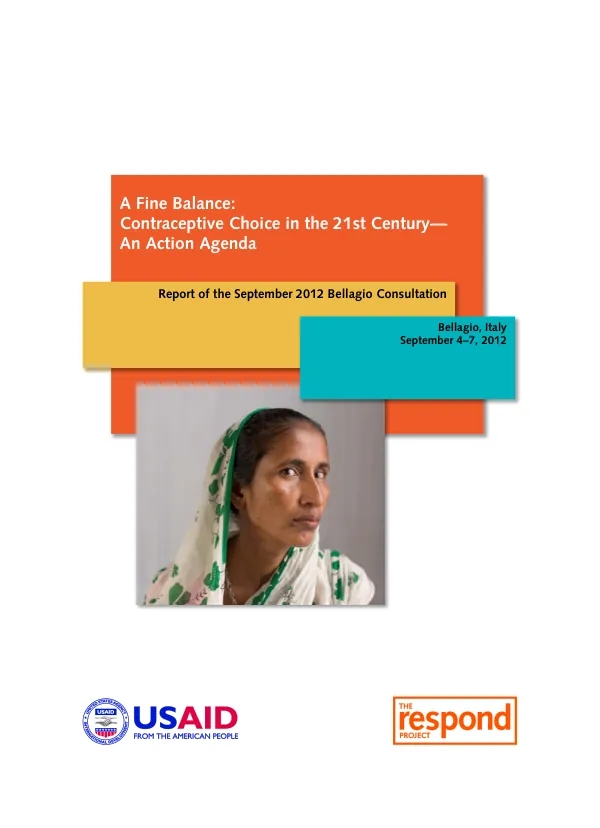
A Fine Balance: Contraceptive Choice in the 21st Century— An Action Agenda Report of the September 2012 Bellagio Consultation
Sign inENGENDERHEALTH
A Fine Balance: Contraceptive Choice in the 21st Century— An Action Agenda Report of the September 2012 Bellagio Consultation
Contraceptive choice is a fundamental human right, yet it remains a challenge for many women and couples worldwide.
2013 · 16 pages
Sign in to readA free account is required to download.
Abstract
The concept of informed contraceptive choice encompasses the ability of individuals and couples to decide freely the number and timing of their births, access a choice of contraceptive options, and experience neither barriers nor coercion in putting their decisions and intentions into practice. The intersection of contraceptive choice and human rights was explored by experts from 11 countries at a consultation convened by EngenderHealth's RESPOND Project in September 2012 at the Rockefeller Foundation Bellagio Center in Bellagio, Italy. The meeting aimed to examine issues that influence contraceptive choice, identify factors that support the two dimensions of choice, and develop recommended actions and messages for donors, governments, program leaders, and civil society. Key conclusions emerged from the discussions, including the assertion that contraceptive choice is a right that needs to be promoted and protected, and programs need to be held accountable. The International Conference on Population and Development (ICPD) Programme of Action in 1994 and the United Nations Summit on the Millennium Development Goals in 2010 reaffirmed the right to informed choice in family planning. In practice, informed contraceptive choice means that individuals and couples can decide freely whether or not to use contraception, have access to a choice of contraceptive options, and experience neither barriers nor coercion in putting their decisions and intentions into practice. However, despite national and international commitments, reality has not caught up with the rhetoric in many countries where women and couples have few real family planning options. Female sterilization has an important role to play as an option for women and couples who want no more children, and it should be made available by programs that protect informed choice and quality of care. The availability of female sterilization varies both among and within countries, and it is the method most often associated with rights abuses, which has created sensitivity that has led to reduced investment and availability. To promote and protect contraceptive choice, planners and managers need to increasingly incorporate clients' voices and the client's perspective when planning and monitoring programs. When deciding what methods to invest in, planners and managers need to consider method attributes that matter to clients, such as safety, effectiveness, affordability, and acceptability. As part of routine monitoring and evaluation, they should assess the availability and accessibility of contraceptive options, including female sterilization, and identify barriers to access that prevent individuals from obtaining family planning information and services. The consultation also highlighted the need for programs to be held accountable for promoting and protecting contraceptive choice. This requires a commitment to ensuring that all women, men, and young people have information about, access to, and choice of the widest possible range of safe, effective, affordable, and acceptable methods of family planning. By working together, we can advance from discourse to action to ensure that contraceptive choice in the 21st century is attained to enable women and men to achieve their reproductive intentions through voluntary use of family planning.