USAID DEC
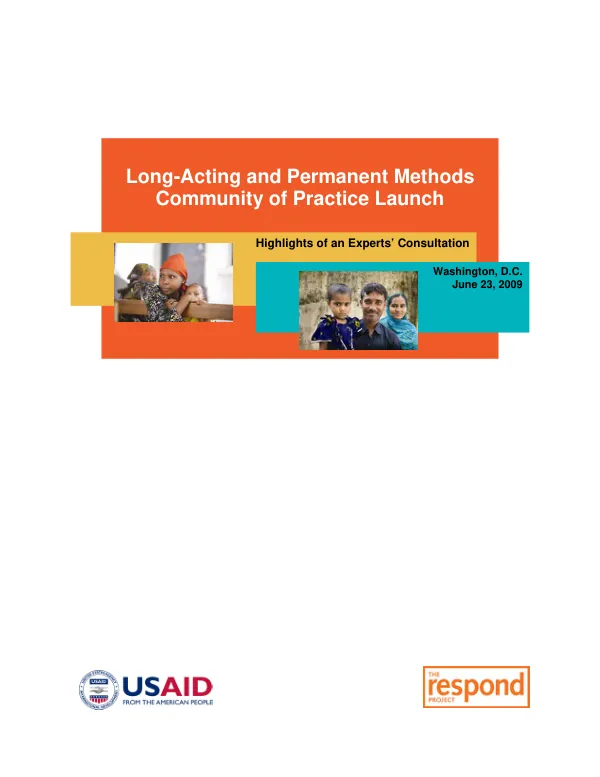
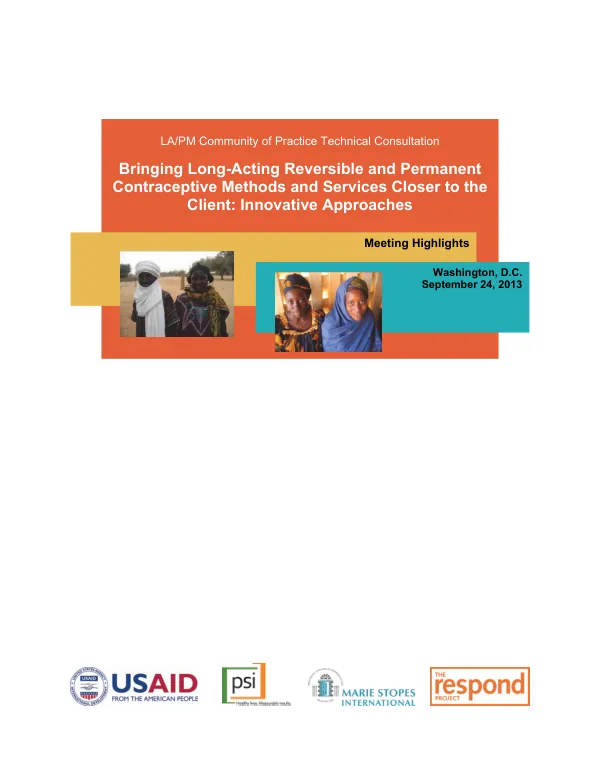
LA/PM Community of Practice Technical Consultation: Bringing Long-Acting Reversible and Permanent Contraception Methods and Services Closer to the Client: Innovative Approaches
Sign inENGENDERHEALTH
LA/PM Community of Practice Technical Consultation: Bringing Long-Acting Reversible and Permanent Contraception Methods and Services Closer to the Client: Innovative Approaches
The Long-Acting and Permanent Methods (LA/PM) Community of Practice convened a technical consultation to stimulate learning and foster an exchange of experience among family planning professionals.
2013 · 12 pages
Sign in to readA free account is required to download.
Abstract
The consultation, cohosted by EngenderHealth, Marie Stopes International, Population Services International, and the U.S. Agency for International Development, focused on mobile outreach and dedicated provider approaches for bringing long-acting reversible contraceptives (LARCs) and permanent methods (PMs) closer to the client. The specific objectives were to share evidence-based experiences, discuss effective service approaches in different contexts, and identify areas for further study and documentation. Seventy-one participants from 18 organizations attended the consultation. Harriet Stanley, Project Director of the RESPOND Project/EngenderHealth, served as the chair for the consultation. Ellen Starbird, Director of the Office of Population and Reproductive Health, Bureau for Global Health, USAID, welcomed everyone and thanked the cohosts for hosting the meeting. The consultation highlighted the importance of focusing on LARCs and PMs, as well as the need to expand women's choices of and access to these methods within a mix of contraceptive options. Patricia MacDonald, LA/PM Co-Champion, emphasized the value of mobile services and dedicated provider approaches that offer a full range of contraceptives and/or bring methods that are not available at lower levels. She asked whether these approaches should be considered an integral part of the overall health service delivery system. Jane Wickstrom, Technical Team Leader of the RESPOND Project/EngenderHealth, presented on "Approaches to Mobile Outreach Services: Malawi, Nepal, and Tanzania." The study found that there is no "blueprint" for programming and managing mobile outreach services, and that most outreach services are provided at public-sector facilities. Community health workers or volunteers play a role in educating clients about family planning, including LA/PMs, and informing them about the schedule for mobile services. The study also found that mobile services have been successful in increasing access to LARCs and PMs. In Tanzania, half of all LA/PMs accepted were provided via mobile services, while in Malawi, more than 170,000 female sterilizations were performed in four years, with over 90% of those offered by the largest local NGO provided via mobile outreach. In Nepal, 33% of all no-scalpel vasectomy procedures and 19% of all female sterilizations were conducted in mobile settings. The consultation also highlighted the challenges and opportunities of mobile outreach services, including maintaining quality of care, public-private partnerships, and continuing financing. Ms. Wickstrom offered a proposition for the LA/PM CoP: FP mobile outreach services are here to stay, specifically targeted to meet the poor and underserved, and should be supported by the international FP community to evolve and grow within the health care system. The consultation provided a platform for sharing experiences and discussing effective service approaches in different contexts. The study on mobile outreach services in Malawi, Nepal, and Tanzania highlighted the importance of community health workers and volunteers in educating clients about family planning and informing them about mobile services. The consultation also emphasized the need to strengthen the link between commodity security and planning for scaling up access to LARCs and PMs. The consultation was a step towards informing strategic thinking and programming within the family planning community. The study on mobile outreach services and the discussion on effective service approaches will contribute to the development of innovative approaches to bring LARCs and PMs closer to the client. The consultation also highlighted the importance of public-private partnerships and continuing financing to support the growth of mobile outreach services.
Related documents