USAID DEC
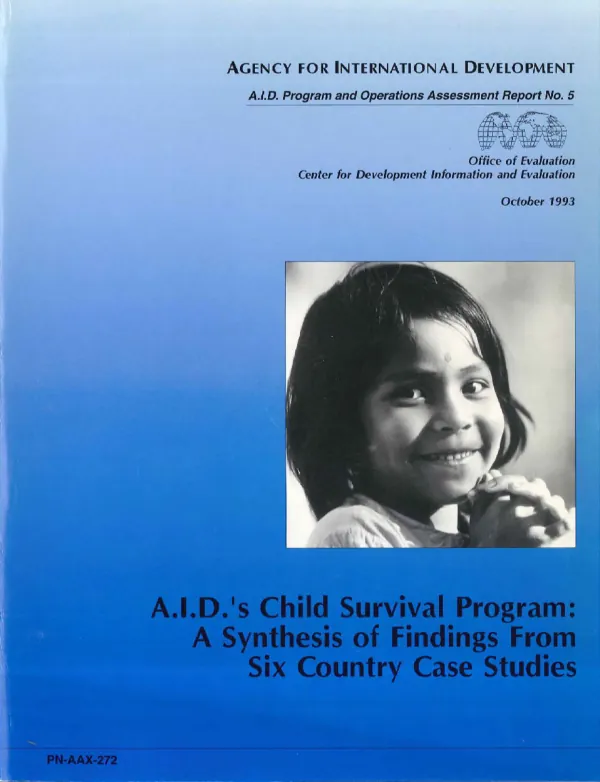
A.I.D."s child survival program : a synthesis of findings from six country case studies
Sign inUSAID. BUR. FOR POLICY AND PROGRAM COORDINATION. CENTER FOR DEVELOPMENT INFORMATION AND EVALUATION (CDIE)
A.I.D."s child survival program : a synthesis of findings from six country case studies
Findings from evaluations of A.I.D.
Martin, Richard · 1993
Sign in to readA free account is required to download.
Abstract
child survival (CS) programs in six countries -- Bolivia, Egypt, Haiti, Indonesia, Malawi, and Morocco -- are synthesized. According to the report, institution building may be the unsung success of the program: in three of the six countries examined, A.I.D. has been instrumental in developing innovative institutional arrangements for providing low-cost services. Sustainability is a problem, however, in mature programs, such as Egypt and Morocco, where A.I.D. is having problems phasing out support. Other key conclusions are as follows. (1) A.I.D."s CS program has been cost-effective and has played a notable, though not easily quantifiable, part in lowering child mortality and morbidity. (2) A.I.D. has cooperated with other donors in expanding immunization coverage and has taken the lead in reducing high-risk births. A.I.D. has tried to take the lead in oral rehydration therapy as well, but efforts have been disappointing due to underestimation of support requirements. Breastfeeding and vitamin A supplementation appear to have been cost-effective interventions, but impacts in the areas of nutrition, water and sanitation, and acute respiratory infection are unclear. (3) The program is managed by an eclectic group of direct hires, contractors, university fellows, and professionals from other U.S. agencies; staffing needs to be rationalized. A.I.D."s complex administrative requirements have led to long delays, wasted resources, and strained relationships. On the other hand, A.I.D. was wise to concentrate CS resources on selected emphasis countries and has successfully involved the commercial private sector and PVOs. Policy dialogue has been moderately successful, though not in persuading host governments to increase their CS budgets. Donor coordination in CS has been better than in many other social sectors. All in all, the report concludes that the program is successful and should be continued. However, both operational problems and strategic issues are identified and it is recommended that A.I.D."s CS strategy be updated, based on lessons learned during the past 8 years. Other general and specific recommendations are made.