USAID DEC
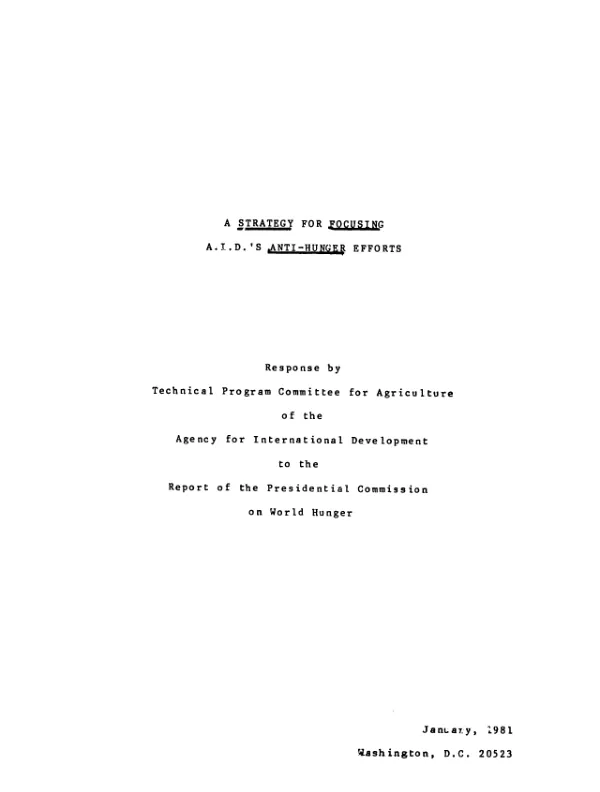
A strategy for focusing A.I.D.’s anti-hunger efforts : response by Technical Program Committee for Agriculture of the Agency for International Development to the report of the Presidential Commission on World Hunger
Sign inUSAID. TECHNICAL PROGRAM COMMITTEE FOR AGRICULTURE
A strategy for focusing A.I.D.’s anti-hunger efforts : response by Technical Program Committee for Agriculture of the Agency for International Development to the report of the Presidential Commission on World Hunger
The Report of the Presidential Commission on World Hunger concluded that the main focus of U.S.
1981
Sign in to readA free account is required to download.
Abstract
policy towards developing countries should be the elimination of chronic malnutrition caused by poverty. In this paper, A.I.D."s Technical Program Committee for Agriculture (TPCA) proposes a strategy to maximize A.I.D."s anti-hunger efforts. After reviewing the current hunger situation, the TPCA concludes that hunger must be attacked on a double front -- improving production while increasing the purchasing power of the hungry. The proposed strategy is aimed at helping developing countries build, over decades, the human and institutional capacity needed to promote small-scale or broad-based, labor-intensive, commercial agriculture, thus employing more people while improving production capacity. To implement such a strategy, A.I.D. should focus on Human and Institutional Resource Development (HIRD) projects, stressing applied agricultural research (especially regarding dry farming) and the establishment of self-sustaining agricultural institutions. A.I.D"s ability to implement such a stategy faces several challenges: lack of trained technical assistance personnel and funds both by A.I.D. (despite U.S. public opinion support for an anti-hunger campaign) and by developing countries; the general lack of political will to eradicate hunger; and A.I.D."s inability to define nutrition goals clearly and pursue them cohesively. Mounting an effective anti-hunger campaign will require that A.I.D. change its structure, especially regarding the management of its own resources and those allocated to other international agencies. This change is essential for building public and political support while attaining a position of credible leadership in the global anti-hunger effort. A total of 15 recommendations concentrate on developing an operational focus, articulating a full commitment, training effective personnel, seeking alternate funding, revising selected regulations, and increasing public education on hunger issues.