USAID DEC
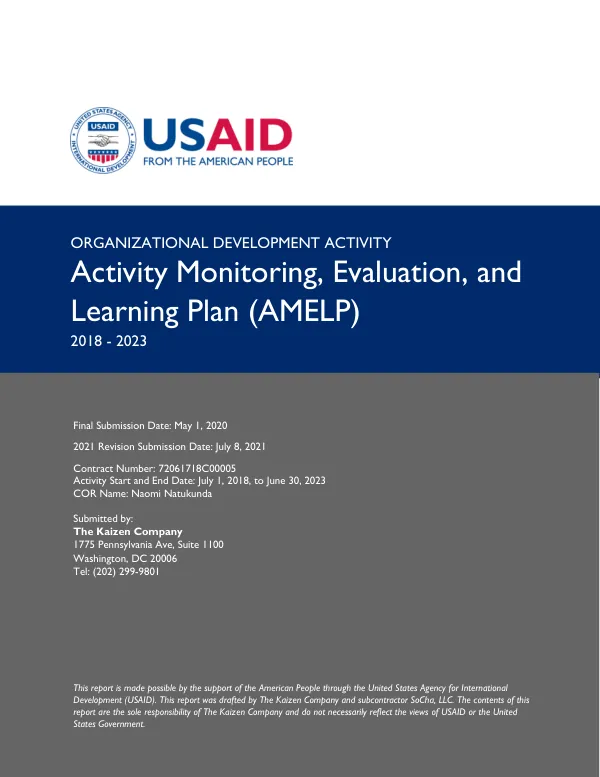
Activity Monitoring, Evaluation, and Learning Plan (AMELP) for Organizational Development Activity (ODA)
Sign inSOCHA, LLC
Activity Monitoring, Evaluation, and Learning Plan (AMELP) for Organizational Development Activity (ODA)
The Organizational Development Activity (ODA) is designed to support and strengthen USAID/Uganda's internal relationships, systems, practices, and culture to deliver and facilitate effective and efficient development advancements for the Ugandan people.
2021 · 32 pages
Sign in to readA free account is required to download.
Abstract
The goal of ODA is to improve the Mission's organizational health, efficiency, and overall capacity to support advancements for the Ugandan people. To achieve this goal, ODA operationalizes the development hypothesis, which states that if the ODA team works through interactive processes, with an ODA Executive Group consisting of a small group of appointed top USAID Mission leadership, who align, agree upon, and support USAID Uganda's overall strategic vision for how the Mission operates, including ODA's overall strategy, six-month goals, and primary tactics for supporting the Mission, then USAID/Uganda will achieve improved organizational health that supports enhanced Mission delivery of exponential development advancements for the Ugandan people. ODA defines Organizational Health (OH) as an organization's ability to align around a common vision, execute against that vision effectively, and continuously renew itself through innovation and creative thinking. ODA has unpacked the definition of OH to identify five interconnected domains of change: Direction and Leadership, Working Environment, Motivation, Capabilities, and Learning and Innovation. Each domain is supported by 2-4 elements that further elaborate specific pathways for improvement. The elements of focus may change every six months as part of an adaptive work planning process. The ODA investment is a continuation and deepening of previous organizational development activities implemented by the Mission since 2012. These activities include developing a Mission Leadership Charter, undertaking Insights Discovery across the Mission to enable understanding of individual and team behavioral profiles, holding Mission-wide retreats, developing Guiding Principles as part of the Country Development and Cooperation Strategy (CDCS), and embedding Collaborating, Learning and Adapting (CLA) into the way the Mission approaches development. ODA will contribute to the advancement of development goals through nontraditional approaches, adopting a complexity-aware approach to achieving results. This approach is necessary because cause-and-effect relationships are uncertain, Uganda's wide range of relevant stakeholders bring diverse perspectives to achieving the CDCS, contextual factors are likely to influence CDCS success, new opportunities or new needs continue to arise in the Ugandan context, and the pace of change to Mission OH is unpredictable. In practice, operationalizing and strengthening the five domains of OH require that the ODA team interactively work with Mission leadership to align, agree upon, and support USAID/Uganda's overall strategic vision for how the Mission operates and its primary tactics. The AMELP presents a framework for monitoring ODA's outputs, capturing how these outputs will contribute to outcomes that incrementally improve the five domains of OH, measuring OH over time, and identifying how ODA contributions to the Mission's goal of development advancements for the Ugandan people can be determined. Unlike traditional AMELPs, ODA's AMELP cannot pre-specify the pathway to change through simple, quantitative targets. Rather, substantive change will occur through the interactive processes and adaptable six-month work plans. The ODA team will work closely and collaboratively with Mission leadership and staff, coordinating its efforts with other USAID-sponsored activities, especially the Uganda Learning Activity (ULA). As a result, ODA-driven improvements to the Mission's OH will form a substantial contribution to the development advancements for the Ugandan people. The AMELP has been reviewed and revised periodically to ensure it accurately reflects ODA learning over the course of the activity. The AMELP outlines the measurement approach, which includes tracking and measuring organizational development interventions, capturing outcomes and progress within Organizational Health domains, capturing perceived ODA performance and USAID/Uganda Organizational Health, and monitoring approach summary. The learning approach includes learning questions, such as how do Organizational Health improvements affect Organizational Performance, what is most important for future USAID OD efforts, and how do organizational health improvements affect organizational performance. The management of AMELP includes staffing, roles, and responsibilities, information management, reporting, MEL oversight, home office support, and data quality assessments and evaluations. The Performance Indicator Reference Sheets (PIRS) are also outlined in the AMELP, which provide a framework for tracking ODA contributions and outputs by element.