USAID DEC
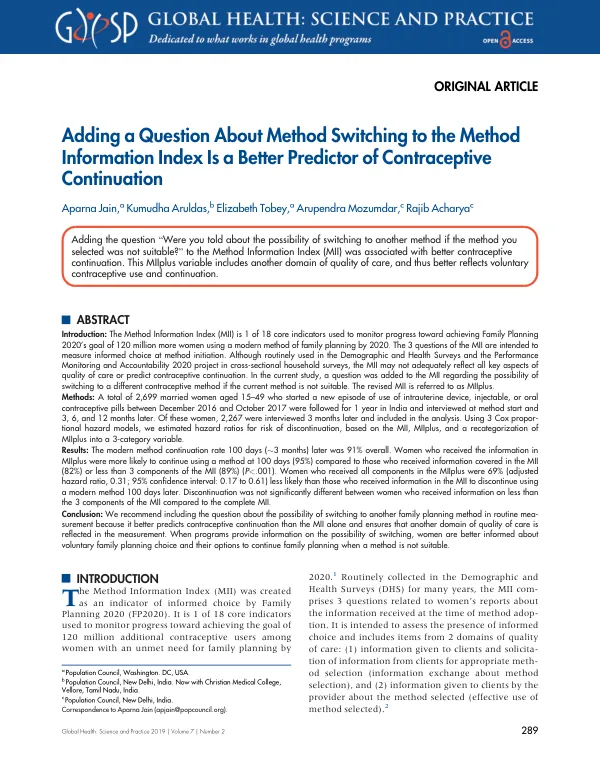
Adding a Question About Method Switching to the Method Information Index Is a Better Predictor of Contraceptive Continuation
Sign inMINISTRY OF HEALTH
Adding a Question About Method Switching to the Method Information Index Is a Better Predictor of Contraceptive Continuation
The Method Information Index (MII) is a core indicator used to monitor progress toward achieving Family Planning 2020's goal of 120 million more women using a modern method of family planning by 2020.
2019 · 11 pages
Sign in to readA free account is required to download.
Abstract
The MII comprises 3 questions related to women's reports about the information received at the time of method adoption. These questions are intended to assess the presence of informed choice and include items from 2 domains of quality of care: information exchange about method selection and effective use of the method selected. The 3 questions of the MII are: Were you informed about other methods of family planning? Were you informed about possible side effects or problems you might have with the method? Were you told what to do if you experience any side effects or problems? Women who respond yes to all 3 questions are considered to have received full information, based on the MII. The MII questions are routinely collected in the Demographic and Health Surveys (DHS) and the Performance Monitoring and Accountability 2020 (PMA2020) project in cross-sectional household surveys. However, the MII may not adequately reflect all key aspects of quality of care or predict contraceptive continuation. To investigate this, a question was added to the MII regarding the possibility of switching to a different contraceptive method if the current method is not suitable. The revised MII is referred to as MIIplus. The MIIplus includes the 3 original MII questions, plus the additional question: Were you told about the possibility of switching to another method if the method you selected was not suitable? A longitudinal study was conducted in India to investigate whether adding the MIIplus question was associated with a reduced risk of modern method discontinuation 100 days later compared with receiving information in the MII alone. The study followed 2,699 married women aged 15-49 who started a new episode of use of intrauterine device, injectable, or oral contraceptive pills between December 2016 and October 2017. The women were interviewed at method start and 3, 6, and 12 months later. The results showed that women who received the information in MIIplus were more likely to continue using a method at 100 days (95%) compared to those who received information covered in the MII (82%) or less than 3 components of the MII (89%). Women who received all components in the MIIplus were 69% less likely than those who received information in the MII to discontinue using a modern method 100 days later. Discontinuation was not significantly different between women who received information on less than the 3 components of the MII compared to the complete MII. The study suggests that including the question about the possibility of switching to another family planning method in routine measurement is associated with better contraceptive continuation. When programs provide information on the possibility of switching, women are better informed about voluntary family planning choice and their options to continue family planning when a method is not suitable.
Related documents