JHPIEGO
Pre and Post Test-Questionnaire for OCPs SD
The oral contraceptive pills (OCPs) are a widely used family planning method in India.
2016 · 3 pages
Sign in to readA free account is required to download.
Abstract
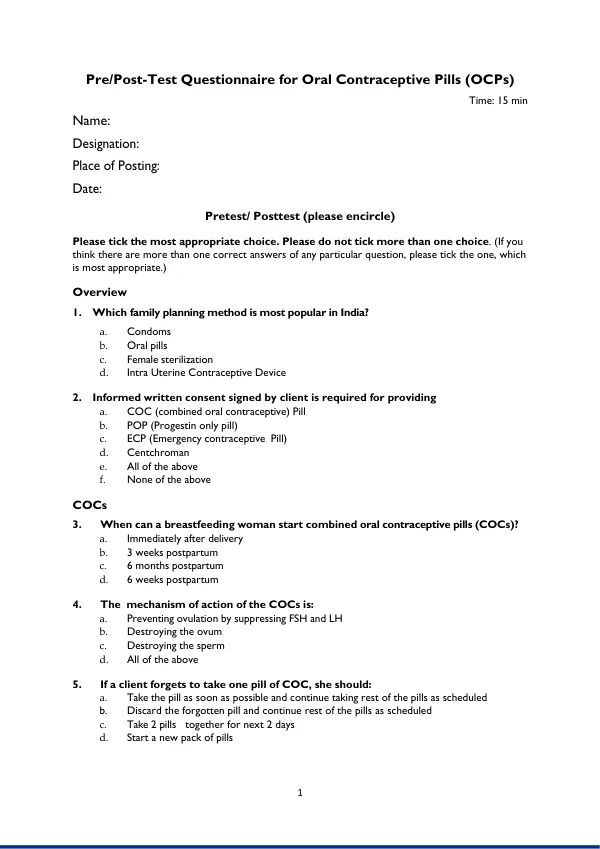
According to the data, the most popular family planning method in India is female sterilization. However, the use of OCPs is also prevalent, particularly among women who prefer reversible methods of contraception. Informed written consent is a crucial aspect of providing OCPs to clients. The consent must be signed by the client before initiating the treatment. This is a requirement for all types of OCPs, including combined oral contraceptive (COC) pills, progestin-only pills (POPs), and emergency contraceptive pills (ECPs). The consent ensures that the client is aware of the benefits and risks associated with the use of OCPs. The mechanism of action of COCs involves preventing ovulation by suppressing follicle-stimulating hormone (FSH) and luteinizing hormone (LH). This prevents the release of an egg from the ovary, thereby preventing fertilization. COCs are effective in preventing pregnancy when taken correctly, but they may not be suitable for all women, particularly those with a history of blood clots or stroke. Breastfeeding women can start taking COCs after 6 weeks postpartum. However, they should not take COCs immediately after delivery, as this may affect milk production. The COCs should be taken as directed, and any missed pills should be taken as soon as possible to maintain their effectiveness. The advantages of COCs include their effectiveness in preventing pregnancy, protection against ovarian and endometrial cancer, and relief from symptoms of endometriosis. However, COCs may not be suitable for all women, particularly those with a history of blood clots or stroke. They may also increase the risk of ovarian and endometrial cancers in some women. COCs should not be used by women suffering from migraine, heavy smokers over 35 years, or those with a history of blood clots or stroke. They should also not be used by breastfeeding women, particularly those with a history of blood clots or stroke. POPs, on the other hand, can be taken by breastfeeding women after 6 weeks postpartum. However, they should not be taken by women with a history of breast cancer, severe liver disease, or liver infection. POPs can be given to women who have unexplained vaginal bleeding, but they should not be used by women who smoke cigarettes, regardless of their age. The dosage of Centchroman is once a week for 3 months followed by twice a week from the 4th month onwards. Centchroman contains norethindrone enanthate, a synthetic progesterone. It is not suitable for women who are breastfeeding their babies, have anemia, varicose veins, or polycystic ovarian disease. If a woman misses a Centchroman pill, she should take the missed pill as soon as possible. If the pill is missed by less than 7 days, she should continue with the normal schedule, and no backup is needed. However, if the pill is missed by more than 7 days, she needs to continue the usual schedule and take a backup for 7 days. Emergency contraceptive pills (ECPs) are effective when taken within 72 hours of last unprotected sex. They contain high-dose progestin and are available as a single pill pack containing Levonorgestrel (1.5 mg per tablet) in the National Family Planning Program. ECPs are not suitable for use as a regular contraceptive method and should only be used in emergency situations.