USAID
Adolescent Fertility Data Reference Guide
Adolescent fertility remains a national and international priority in Nepal due to its significant impact on girls' education, employment opportunities, and health outcomes.
2021 · 3 pages
Sign in to readA free account is required to download.
Abstract
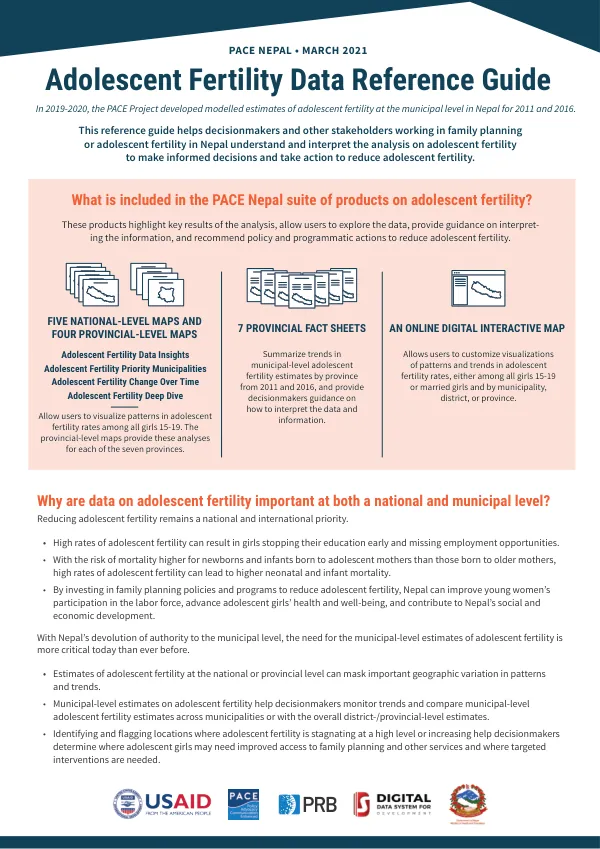
High rates of adolescent fertility can lead to girls stopping their education early, missing employment opportunities, and experiencing higher mortality rates among their newborns and infants. By investing in family planning policies and programs, Nepal can improve young women's participation in the labor force, advance adolescent girls' health and well-being, and contribute to the country's social and economic development. The devolution of authority to the municipal level in Nepal highlights the need for municipal-level estimates of adolescent fertility. Estimates at the national or provincial level can mask important geographic variation in patterns and trends. Municipal-level estimates help decisionmakers monitor trends and compare adolescent fertility estimates across municipalities or with the overall district-/provincial-level estimates. Identifying and flagging locations where adolescent fertility is stagnating at a high level or increasing enables decisionmakers to determine where adolescent girls may need improved access to family planning and other services and where targeted interventions are needed. The PACE Nepal suite of products on adolescent fertility includes five national-level maps, four provincial-level maps, seven provincial fact sheets, and an online digital interactive map. These products highlight key results of the analysis, allow users to explore the data, provide guidance on interpreting the information, and recommend policy and programmatic actions to reduce adolescent fertility. The Adolescent Fertility Data Insights maps show the 2016 adolescent fertility rate (AFR) and the percent change in AFR from 2011 to 2016 by municipality. The Adolescent Fertility Priority Municipalities maps specifically highlight municipalities that have high AFRs that are stagnant or increasing and an estimated 1,000 or more births to adolescent girls from 2011 to 2016. Decisionmakers can use the information from the analysis to develop evidence-based policies and programs. Such analyses can help decisionmakers define priority municipalities and subgroups who would benefit from targeted interventions to address adolescent fertility. Policymakers should focus efforts and resources on municipalities with high AFRs that are stagnant or increasing, as well as a large absolute number of births to adolescent girls. Targeted interventions could include investing in programs to create and reinforce positive social norms, supporting programs to help newly married adolescent girls stay in school, and providing adolescent-friendly, confidential family planning services. The methodology used to estimate adolescent fertility rates is based on the distribution of educational attainment and the time adolescent girls spend in marriage. The AFR is equal to the number of births to girls ages 15-19 per 1,000 girls ages 15-19 in the population. The estimates are averaged over five years (from 2006 to 2011 and from 2011 to 2016). The municipal-level AFR estimates are based on the educational attainment of adolescent girls and their time spent in marriage and do not account for the impact of other factors. The current analysis highlights the need for additional research and data collection on adolescent fertility. The data highlight the importance of having good-quality vital registration on births at the municipal level for consistent and timely monitoring of trends in adolescent fertility and other important indicators at the local level. A recent 2019 Nepal Multiple Indicator Cluster Survey reported a national AFR substantially lower than the 2016 Nepal Demographic and Health Survey (DHS) estimate. However, differences in the sampling and methodology between the two surveys indicate that additional research and data collection will need to be done to validate this estimate.
Related documents