INTERNATIONAL MAIZE AND WHEAT IMPROVEMENT CENTER (CIMMYT)
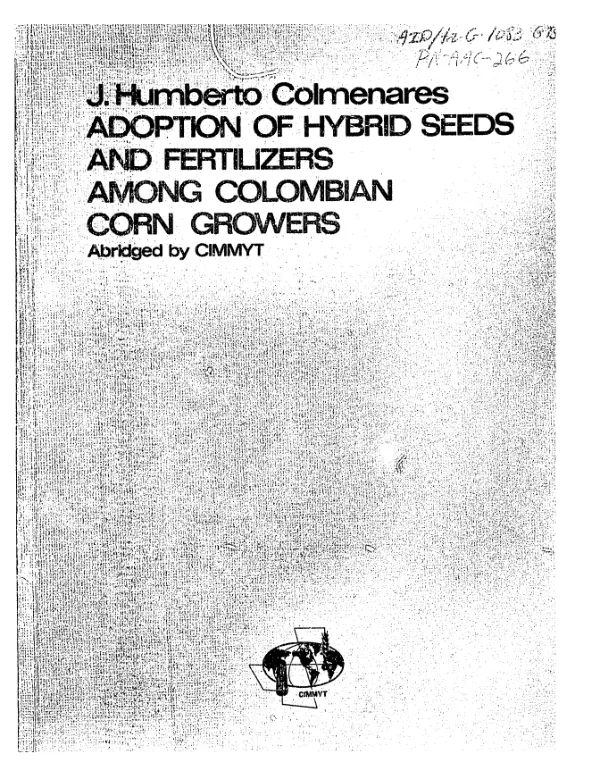
Adoption of hybrid seeds and fertilizers among Colombian corn growers
Summarized in this report are the results of a study of 738 maize producers in Colombia.
Colmenares, J. H. · 1970
Sign in to readA free account is required to download.
Abstract
The study completed in 1975, is based on survey work conducted in 1973. Its purpose was to establish the extent to which various categories of farmers adopt improved technology in the form of hybrid seeds, chemical fertilizers, or both. The farms were categorized into low, intermediate, and high-altitude zones. The findings showed that services concerned with the distribution of technical assistance were provided essentially to the large growers of Zone 1 (low land), while extension services which were not necessarily connected to credit were given to small and subsistence producers. Over 32 percent of the large farmers growing maize in pure stand in Zone 1 received both credit and technical advice. The corresponding figures among the large farmers in Zones 2 and 3 were 7, 20, and 73 percent, respectively. Among all small medium farmers growing maize in pure stand, 5 percent received technical advice and credit, 16 percent received only one or the other, and 79 percent indicated they received neither service. The data showed relatively large yield differences between farmers using the credit and those not using them. The main conclusion drawn from direct interviews with farmers in the three zones was that adoption levels are generally low. The level of adoption of fertilizer in Zones 1, 2 and 3 was 26, 10 and 18 percent, respectively. The level of adoption of hybrid seeds was 36, 18 and 7 percent respectively. High adoption levels occur mostly in Zone 1 among growers with favorable characteristics of size, tenure, topography, and higher levels of formal education. These are also the farmers with greater access to specialized services such as credit and professional advice. However, a relatively large proportion of adopters in the large-size group did not receive those services. Hybrid adoption was highly related to the use of credit. Other things equal, farmers in Zone I were 44 percent more likely to be using hybrids if they were also using credit. The study established that policy instruments and agroclimatic differences do affect adoption of maize technology among different farmers. However, the evidence also suggested that the policy variables, credit and technical advice, were a part of the adoption package; these services seemed to improve the opportunity for adoption, but their presence or absence may not explain adoption of hybrid maize seeds or fertilizers. There were clear differences between zones, but differences within Zone 1 were larger than those between zones. Further research is needed among producers in Zone 1 to determine the reasons for such differences and to establish the role of policy instruments. This would improve the knowledge of agricultural economics in Colombia, and provide a better base for future policy decisions.
Related documents