USAID
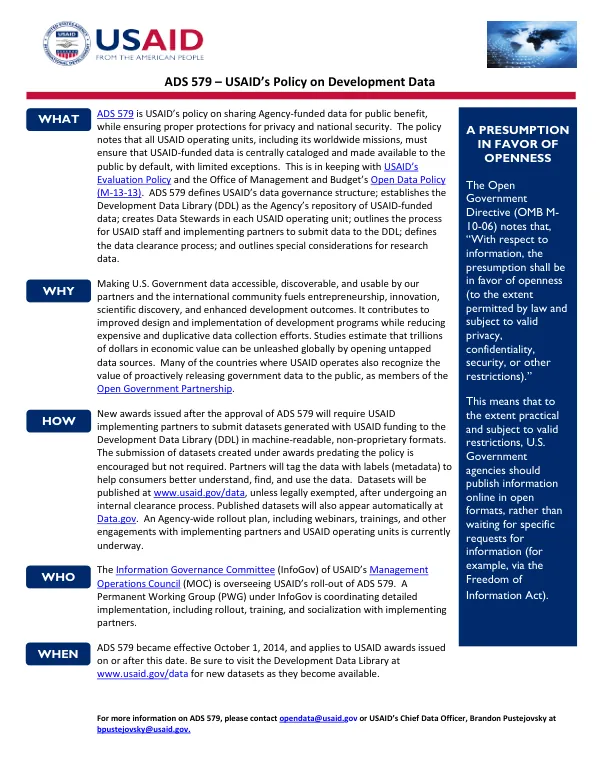
ADS 579 – USAID’s Policy on Development Data
USAID's Policy on Development Data, ADS 579, aims to promote the sharing of Agency-funded data for public benefit while ensuring proper protections for privacy and national security.
2014 · 1 pages
Sign in to readA free account is required to download.
Abstract
The policy requires all USAID operating units, including worldwide missions, to centrally catalog and make available USAID-funded data to the public by default, with limited exceptions. This aligns with USAID's Evaluation Policy and the Office of Management and Budget's Open Data Policy (M-13-13). The policy defines USAID's data governance structure, establishes the Development Data Library (DDL) as the Agency's repository of USAID-funded data, and creates Data Stewards in each USAID operating unit. It also outlines the process for USAID staff and implementing partners to submit data to the DDL, defines the data clearance process, and addresses special considerations for research data. The policy emphasizes the importance of making U.S. Government data accessible, discoverable, and usable by partners and the international community, which can fuel entrepreneurship, innovation, scientific discovery, and enhanced development outcomes. New awards issued after the approval of ADS 579 require USAID implementing partners to submit datasets generated with USAID funding to the Development Data Library (DDL) in machine-readable, non-proprietary formats. While the submission of datasets created under awards predating the policy is encouraged but not required, partners are expected to tag the data with labels (metadata) to help consumers better understand, find, and use the data. Datasets will be published at www.usaid.gov/data, unless legally exempted, after undergoing an internal clearance process. Published datasets will also appear automatically at Data.gov. The Information Governance Committee (InfoGov) of USAID's Management Operations Council (MOC) oversees USAID's roll-out of ADS 579, with a Permanent Working Group (PWG) under InfoGov coordinating detailed implementation, including rollout, training, and socialization with implementing partners. ADS 579 became effective October 1, 2014, and applies to USAID awards issued on or after this date. The Development Data Library at www.usaid.gov/data provides access to new datasets as they become available. The Open Government Directive (OMB M-10-06) notes that a presumption in favor of openness should be applied to information, subject to valid restrictions. This means that U.S. Government agencies should publish information online in open formats, rather than waiting for specific requests for information. By promoting openness and transparency, USAID aims to enhance development outcomes and contribute to improved design and implementation of development programs.
Related documents