USAID
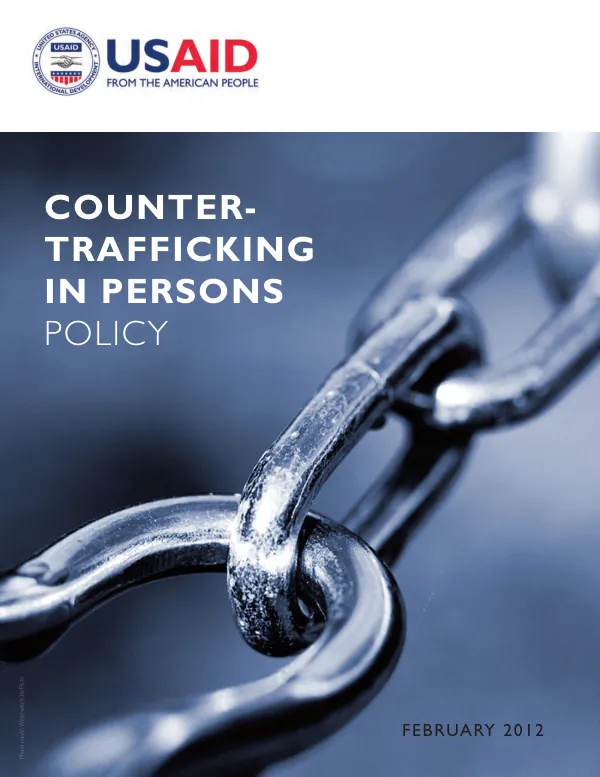
Counter-Trafficking in Persons Policy
The 2012 Counter-Trafficking in Persons Policy is a direct response to the fact that trafficking in persons (TIP) is a massive development problem affecting millions of men, women, and children around the globe.
2012 · 20 pages
Sign in to readA free account is required to download.
Abstract
This new policy reflects the large body of law that has emerged in the last several decades to combat this crime. It incorporates the principles set forth in the U.S. Trafficking Victims Protection Act of 2000 and adheres to the standards in the UN Protocol to Prevent, Suppress and Punish Trafficking in Persons, Especially Women and Children. The policy is informed by the "4Ps" paradigm: Prevention, Protection, Prosecution, and Partnership. TIP is fueled by demand for prostitution and cheap labor and facilitated by porous borders, absent rule of law, failure to prosecute traffickers, complicity of corrupt officials, and modern communication technology. Families may give or sell their children to traffickers, while young adults may be lured into the trade by local or global criminal networks. Trafficking can impede efforts to improve health, increase economic growth, achieve gender equality and women's empowerment, and pose a threat to lifetime prospects for youth. Quantifying the scale of human trafficking around the world is challenging due to the difficulty of collecting accurate data on this clandestine trade. Recent estimates of the number of people enslaved in sex or labor exploitation range from 12 to 27 million. TIP is an international crime involving the acquisition of a human being through the use of force, fraud, or coercion for the purpose of exploiting the individual for profit through forced labor or prostitution. The Palermo Protocol defines human trafficking as the recruitment, transportation, transfer, harboring or receipt of persons, by means of the threat or use of force or other forms of coercion, of abduction, of fraud, of deception, of the abuse of power or of a position of vulnerability or of the giving or receiving of payments or benefits to achieve the consent of a person having control over another person, for the purpose of exploitation. Exploitation shall include, at a minimum, the exploitation of the prostitution of others or other forms of sexual exploitation, forced labor or services, slavery or practices similar to slavery, servitude or the removal of organs. The policy places a strong emphasis on harnessing the power of innovation to combat trafficking. Recent technological advances, such as the widespread use of mobile phones and online social networks, have opened new frontiers in the fight against trafficking, as well as new doors for traffickers. The policy will develop creative partnerships and approaches to utilize technology at the same time it helps prevent its abuse. The policy also emphasizes the importance of prevention and protection. It recognizes that families may give or sell their children to traffickers, and that young adults may be lured into the trade by local or global criminal networks. The policy aims to prevent trafficking by addressing the root causes of the problem, such as poverty, lack of education and employment opportunities, and weak social safety nets. The policy will also focus on protecting victims of trafficking. It recognizes that victims are often vulnerable and in need of support and services. The policy aims to provide victims with access to safe housing, medical care, and counseling, as well as to help them rebuild their lives and reintegrate into their communities. The policy will also prioritize prosecution and partnership. It recognizes that trafficking is a crime that requires a coordinated response from governments, civil society, and the private sector. The policy aims to strengthen partnerships between governments, civil society, and the private sector to combat trafficking, and to support the prosecution of traffickers. The policy will also emphasize the importance of measuring impact and bringing to scale effective programs. It recognizes that combating trafficking requires a data-driven approach, and that evaluations and research are essential to inform programming and improve outcomes. The policy aims to establish a foundation of systematic, empirical data that will inform evaluations and improve efforts to combat trafficking. The policy will also focus on developing regional approaches to combat trafficking. It recognizes that trafficking is a global problem that requires a global response. The policy aims to develop regional approaches to combat trafficking, and to support the development of regional strategies and plans to combat trafficking. Overall, the 2012 Counter-Trafficking in Persons Policy is a comprehensive and ambitious policy that aims to combat trafficking in persons. It reflects the large body of law that has emerged in the last several decades to combat this crime, and it incorporates the principles set forth in the U.S. Trafficking Victims Protection Act of 2000 and adheres to the standards in the UN Protocol to Prevent, Suppress and Punish Trafficking in Persons, Especially Women and Children. The policy is informed by the "4Ps" paradigm: Prevention, Protection, Prosecution, and Partnership, and it emphasizes the importance of harnessing the power of innovation, prevention and protection, prosecution and partnership, measuring impact and bringing to scale effective programs, and developing regional approaches to combat trafficking.
Related documents