BREAKTHROUGH RESEARCH
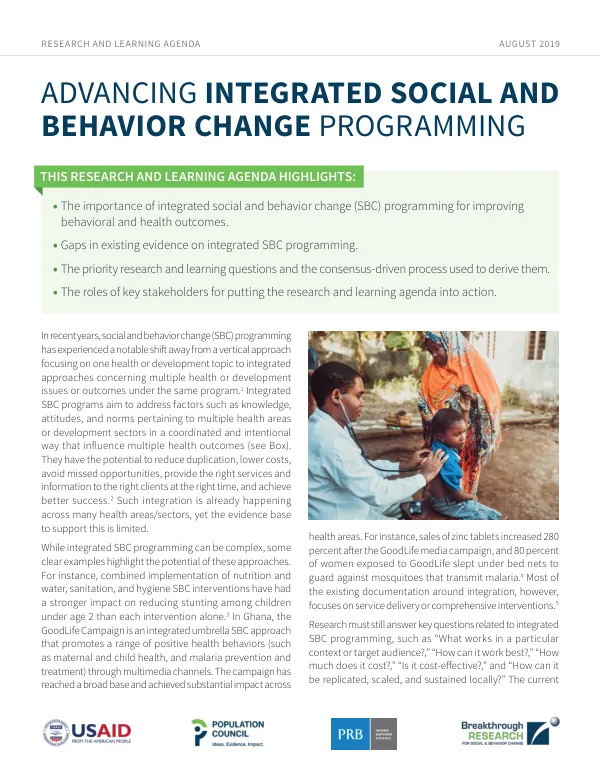
Advancing integrated social and behavior change programming
Integrated social and behavior change (SBC) programming has experienced a notable shift away from a vertical approach focusing on one health or development topic to integrated approaches concerning multiple health or development issues or outcomes under the same program.
2019 · 6 pages
Sign in to readA free account is required to download.
Abstract
Integrated SBC programs aim to address factors such as knowledge, attitudes, and norms pertaining to multiple health areas or development sectors in a coordinated and intentional way that influence multiple health outcomes. They have the potential to reduce duplication, lower costs, avoid missed opportunities, provide the right services and information to the right clients at the right time, and achieve better success. Examples of integrated SBC programs include the GoodLife Campaign in Ghana, which promotes a range of positive health behaviors through multimedia channels, and the Integrated SBCC Implementation Kit, which provides guidance on designing and implementing integrated SBC programs. However, the evidence base to support integrated SBC programming is limited, and research must still answer key questions related to integrated SBC programming, such as "What works in a particular context or target audience?" and "How can it be replicated, scaled, and sustained locally?" A research and learning agenda was developed to help address these evidence gaps, involving 181 SBC experts in a consensus-driven process. The agenda includes a core set of prioritized implementation science questions, which are intended to have broad applicability at global, regional, and local levels, and across health and development sectors. The questions focus on the effectiveness and efficiency of integrated SBC programs, including the impact of integrated SBC on health outcomes, the role of provider behavior change in integrated SBC, and the cost-effectiveness of integrated SBC programs. The research and learning agenda was developed through a multipronged, iterative, and consensus-driven process, involving desk reviews, consultations, and surveys. The process involved gathering input from SBC experts, program implementers, and researchers, and weighing in on the questions generated thus far. The final agenda includes 12 priority research and learning questions, which are intended to guide research and learning efforts in the field of integrated SBC programming. The priority research and learning agenda questions include: * What are the key factors that influence the effectiveness of integrated SBC programs in improving health outcomes? * How can integrated SBC programs be designed and implemented to address the needs of diverse populations and contexts? * What are the cost-effectiveness and cost-benefit implications of integrated SBC programs compared to vertical programs? * How can provider behavior change be integrated into SBC programs to improve health outcomes? * What are the key challenges and barriers to scaling up integrated SBC programs, and how can they be addressed? * How can integrated SBC programs be evaluated to assess their impact on health outcomes and other outcomes of interest? The research and learning agenda is intended to prompt the generation of knowledge that can help focus the global SBC community, development partners, and donors on the most important questions related to the effectiveness and efficiency of integrated SBC programs.
Related documents