ARD INC
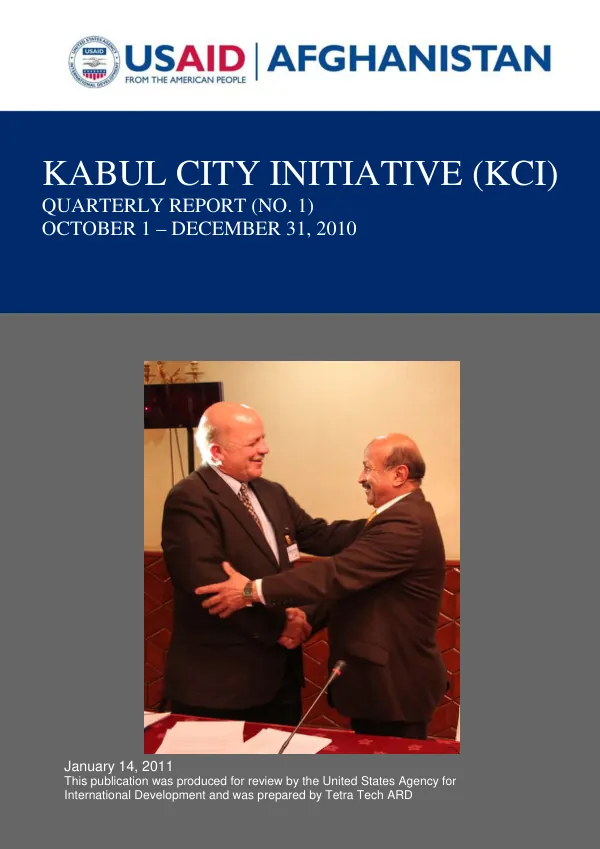
Afghanistan KCI First Quarterly Report: Oct1 – Dec 31, 2010
The Kabul City Initiative (KCI) supports the Kabul Municipality and its Mayor in three important ways.
2011 · 37 pages
Sign in to readA free account is required to download.
Abstract
KCI increases the capacity of city officials to manage the city's resources, both human and material, to improve the level of services, to enable the participation of Kabul citizens in the determination of services to be provided, and to communicate with citizens so they are aware of the improvements and credit the city administration with these accomplishments. KCI assists the city staff to markedly improve the level and quality of services provided, and it increases the ability of the city to generate its own revenues so as to fund the increased level of services that new management capacity makes possible. As a result of KCI, Kabul City citizens will experience consistently improving services provided by a steadily improving city workforce and management. The improved services will be supported by a stronger locally derived revenue base. The public will credit the Kabul City administration with the improvements, become more supportive of Kabul City government, and therefore more likely to participate and to take an active part in improving the urban environment for all. The Kabul City Municipality is a unique government entity in Afghanistan consisting of a central administration and 22 administrative districts. KCI has embedded its project leadership and half its staff with the Mayor and his deputies at the Kabul Municipality, in each of the 22 districts, and in all of its operating departments. KCI staff is now working side by side with city officials on a daily basis. During the first quarter, KCI submitted a draft work plan and Project Management Plan (PMP) for an 18-month period at the verbal request of USAID. Budget and contract modifications are anticipated in the second quarter to align with the approved work plan. The KCI Contract stipulates that reporting is to be done by district. In Quarter 1, however, with limited exceptions, work has been focused on the municipality as a whole or upon departments, with limited district-specific work taking place. The overall quarter 1 achievements of KCI include developing a three-year Municipal Management and Capacity Improvement Plan, building human capacity, developing Standard Operating Procedures (SOPs), implementing a Municipal IT Strategy, improving project management, and increasing public participation. However, several issues and resolutions were also reported during the quarter, including challenges in implementing the Municipal IT Strategy and difficulties in increasing public participation. The KCI Contract Line Item Number (CLIN) 1 achievements and targets for the first quarter include developing a three-year Municipal Management and Capacity Improvement Plan, building human capacity, developing SOPs, implementing a Municipal IT Strategy, improving project management, and increasing public participation. The CLIN 2 achievements and targets for the first quarter include improving Kabul parks and greenery, improving Kabul city sanitation, improving Kabul city streets, commercial area improvement, rehabilitating Kabul city facilities, and establishing at least one private-public partnership. The CLIN 3 achievements and targets for the first quarter include revenue collection and financial management, accounting and financial management, improving property tax register, and improving municipal revenue collection. The financial summary for the first quarter indicates that KCI has made significant progress in implementing its activities and achieving its targets. However, several issues and challenges were also reported during the quarter, including difficulties in implementing the Municipal IT Strategy and challenges in increasing public participation.
Related documents