KABUL MUNICIPALITY
Kabul City Initiative (KCI) Monthly Report: July 2011
The Kabul City Initiative (KCI) supports the Kabul Municipality (KM) in increasing the capacity of city officials to manage resources, improve services, and generate revenue.
2011 · 19 pages
Sign in to readA free account is required to download.
Abstract
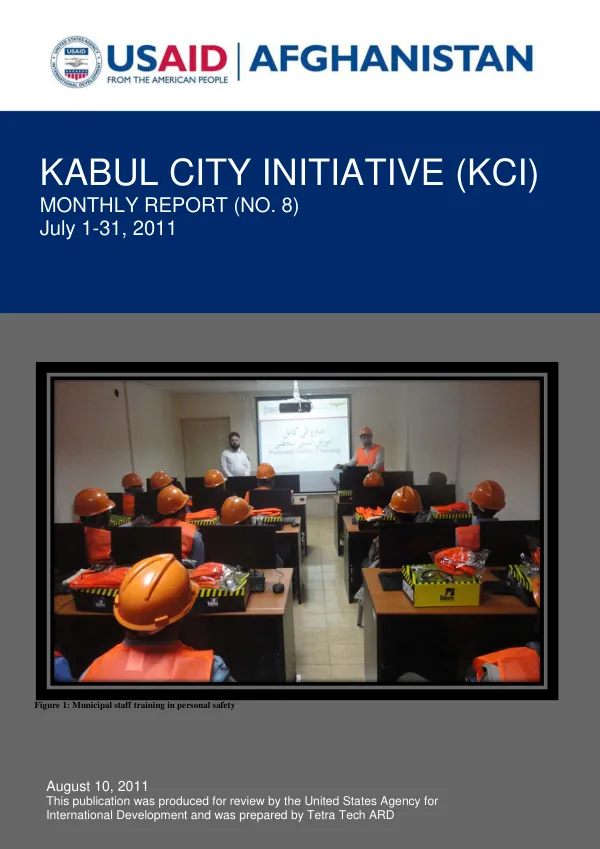
KCI's primary objectives are to enhance the capacity of city officials, improve the level and quality of services provided, and increase the city's ability to generate its own revenues. Training is a key component of KCI's capacity-building efforts. In July 2011, KCI conducted eight trainings for 295 municipal staff, including proposal writing, project management, public outreach, and advanced computer and English training. Three service management and operational trainings were also conducted for 148 municipal employees, focusing on total station training, quality assurance and quality control, and personal protection safety training. Participants of the safety training course were issued standard safety equipment, including steel-toe boots, hard-hats, work gloves, safety glasses, ear protection, and reflective vests. In addition to training, KCI has developed a Kabul Municipality Policy and Procedures Development Workbook to guide the development of department terms of reference, department policy manuals, and department standard operating procedures. Based on the processes in the workbook, KCI and Kabul Municipality have drafted 20 policies, including ICT equipment use policy, ICT internet use policy, social media policy, mobile phone policy, password policy, cash management policy, and sexual harassment policy. KCI has also made significant progress in implementing its objectives. In July 2011, KCI received approval to hold elections for a reformed Women's Representation Council. The initiative has also developed a blog, Facebook page, Twitter account, and Flickr account for the Kabul Mayor. Construction on four city parks began, with KCI collaborating with US Forces for Afghanistan to construct a well in one of the parks to provide water for the greenery. Electrical upgrades were completed at the Department of Sanitation, and a Revenue Improvement Action Plan was developed. The Financial Management Information System (FMIS) was adapted, installed, and networked to KM specifications and functionality, and property valuation records for the Afghan year 1389 were scanned and archived for all districts. KCI's efforts have resulted in significant achievements, including the completion of four core administrative trainings for 132 municipal employees, the development of 20 municipal policies, and the implementation of various projects and initiatives. The initiative's focus on capacity building, service improvement, and revenue generation has contributed to the enhancement of the Kabul Municipality's ability to manage resources, provide services, and generate revenue.
Related documents