 1980
1980USAID DEC
USAID DEC
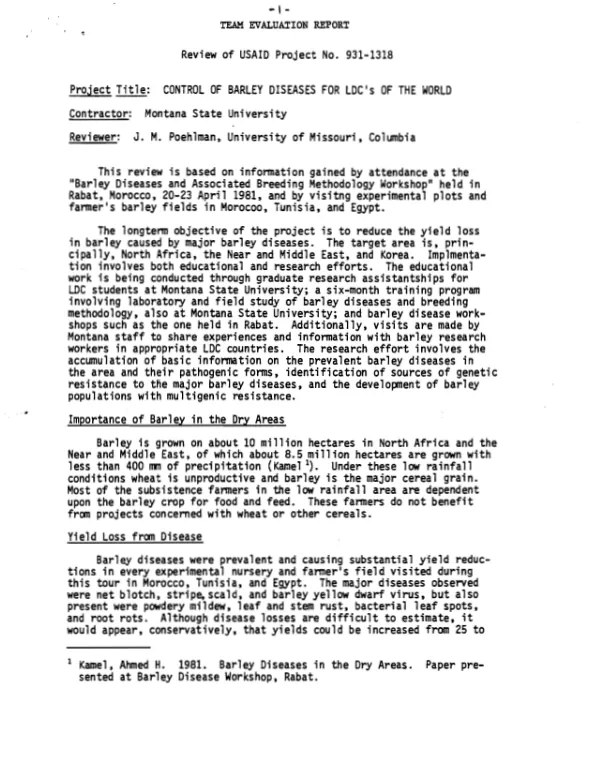
Evaluates project to control or reduce aflatoxin production in maize.
DIENER, URBAN L.; MOSS, DALE N. · 1980
Abstract
This special contracted evaluation covers the period 10/77 to 3/80 and is based on an onsite review. The University of Missouri project team has been stymied by a lack of effective methods to identify resistant maize selections. Although between 500 to 1,000 selections of maize were evaluated, the researchers have been unable to identify resistant materials experimentally. Examples of the methods used include: (1) insertion of a hypodermic needle through the husk and injection of A. flavus spores into the kernels; and (2) inoculation by pin board which involved injuring a double row of kernels and inoculating them with about 1.5 ml of a suspension of a million spores per ml. The first method did not contaminate a sufficient number of kernels for an effective evaluation; the second method was too severe, contaminating all varieties. However, a promising laboratory screening method has been developed that would permit screening of corn lines and crosses in the offseason. Varieties from 20 countries will be selected for testing in 1980. Six research papers and one review publication were produced by the research team during this period (XD-AAG-658-1). The capability of the research team is not in question. Instead, it was an administrative decision to build a P-3 containment laboratory which slowed progress. The 2-year construction of the lab prevented the researchers from determining early in the project that their inoculation techniques were ineffective. The evaluation team recommends a 2-year unfunded extension of the project. Other recommended actions include refinement and modification of the inoculation techniques; reassessment of sampling size and sampling procedures as well as the development of uniformity trials; a review of the aflatoxin-level criterion for resistance in corn kernels; strengthening of international cooperation and ties; and development of an annual report and publication of research accomplishments in normal scientific channels.
Connected topics
Classification