MONTANA STATE UNIVERSITY AT BOZEMAN
Control of barley diseases for LDC"s of the world; team evaluation report
Evaluates project to control barley diseases in LDC"s.
Poehlman, John M. · 1970
Sign in to readA free account is required to download.
Abstract
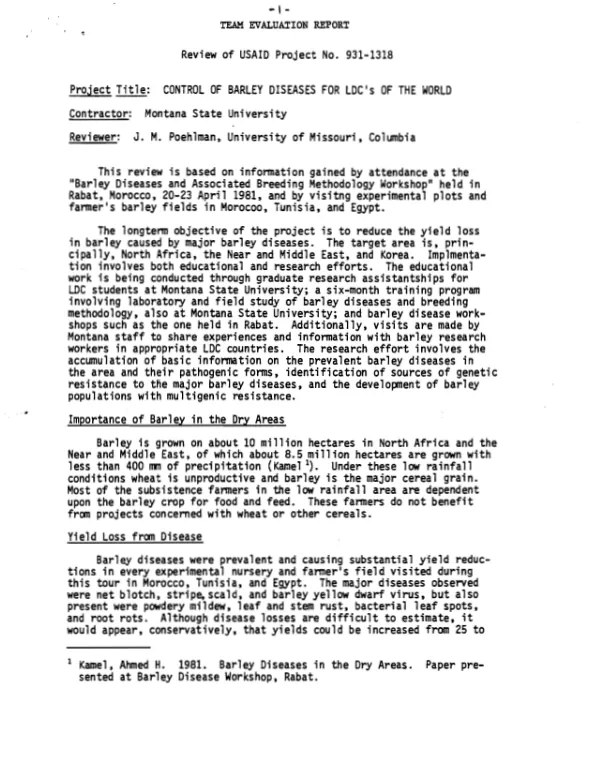
Special evaluation is based on attendance at the Barley Disease and Associated Breeding Methodology Workshop held 4/20-22/81 in Rabat, Morocco, and onsite visits to Morocco, Tunisia, and Egypt. Various efforts are being made by Montana State University (MSU) to reduce barley yield losses. The workshop was attended by about 50 participants from national programs of various LDC"s and from sponsoring organizations. Barley disease problems were discussed; awareness of the problems demonstrated was better than in a 1977 workshop. Criticism of the recurrent selection population (RSP) methodology may have been due to a lack of understanding of this innovative approach. Barley disease research by MSU has involved examination of isolates of pathogens and identification of resistant strains, producing a sufficient base of information for initiating large-scale breeding programs. Local resistance is being developed to scald, net blotch, leaf blotch, and Xanthomonas blight through a process of recurrent selection. The MSU educational program currently involves three Ph.D. candidates from Tunisia, Morocco, and South Korea, and two M.S. candidates from Turkey and Syria; other foreign candidate requests are pending. Three U.S. students have completed degrees - one Ph.D. and two M.S."s. Short-term training has been completed by trainees from India, Turkey, Syria, Morocco, and South Korea. It is recommended that the project be continued. MSU staff should continue communications and annual visits with their graduates and trainees. Consideration should also be given to: introducing additional Mariout or other base germ plasm into the RSP, maximizing disease exposure by growing all RSP"s at as many locations as resources permit, and selecting the most suitable source of strains resistant to barley yellow dwarf virus.