FUND FOR PEACE
Africa Regional Brief: Education
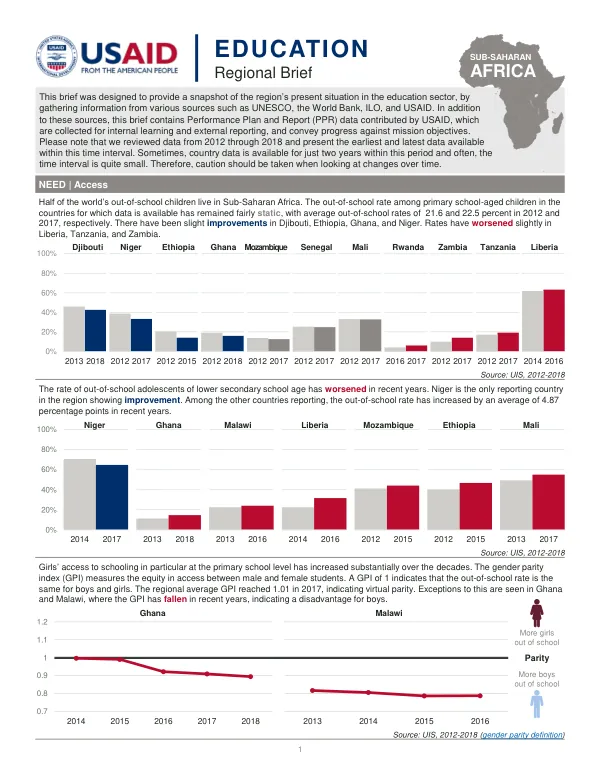
The education sector in Sub-Saharan Africa has faced significant challenges, with half of the world's out-of-school children residing in the region.
2020 · 15 pages
Sign in to readA free account is required to download.
Abstract
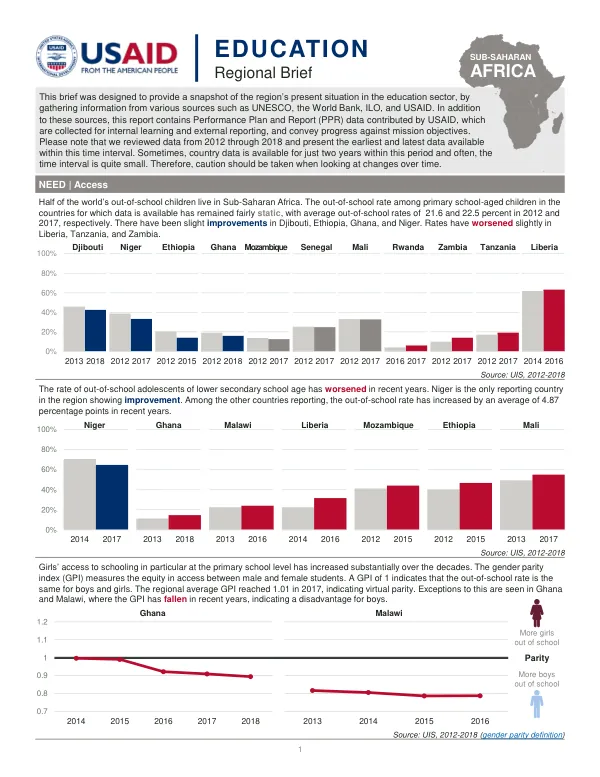
The out-of-school rate among primary school-aged children has remained relatively static, with an average of 21.6% in 2012 and 22.5% in 2017. However, slight improvements have been observed in Djibouti, Ethiopia, Ghana, and Niger, while rates have worsened in Liberia, Tanzania, and Zambia. Girls' access to schooling has increased substantially over the decades, with the gender parity index (GPI) reaching 1.01 in 2017, indicating virtual parity. Exceptions to this trend are seen in Ghana and Malawi, where the GPI has fallen in recent years, indicating a disadvantage for boys. The rate of out-of-school adolescents of lower secondary school age has worsened in recent years, with Niger being the only reporting country showing improvement. The youth literacy rate for ages 15-24 years averages 83% in the latest years available, with Senegal showing a significant improvement and South Africa reaching nearly universal literacy rates among this age group. In the countries reporting, the proportion of students at the end of primary education achieving at least a minimum proficiency in reading and mathematics has significantly improved. Government funding for primary education averages $386 per student in the latest year available, with the biggest increases seen in Ethiopia, Kenya, and Malawi. Funding has decreased substantially in Ghana. In tertiary education, initial government funding per student averages $3,109 in the latest year available, and has increased in many reporting countries in recent years, with exceptions including Ghana, Madagascar, and Niger. The SDGs have set a target for all governments to budget the equivalent of at least 4% of their GDP in order to support equitable education for all. While the government expenditure on education as a percentage of GDP has overall decreased, with the regional average dropping slightly from 4.63 percent in 2012 to 4.33 percent in 2018, many reporting countries are still meeting or exceeding this expenditure target. The number of UNHCR total population of concern – refugees, asylum-seekers, stateless persons, and returned IDPs – has overall increased in the region. The Democratic Republic of the Congo (DRC), Ethiopia, Nigeria, Somalia, South Sudan, and Uganda have all seen sharp increases between 2012 and 2018. Countries reporting the largest reductions include Liberia, Mali, and Kenya. The Fragile States Index aims to assess states' vulnerability to conflict or collapse. The region has generally seen slight reductions in fragility in recent years. The countries highlighted below have had a change in score of 4 points or more. Kenya and Malawi show decreases in fragility, while Mozambique, Mali, and South Africa show an increase in fragility. The largest change is seen in Mali, which has increased by 16+ points and moved from "elevated warning" to "alert" status. USG support in the education sector has impacted student performance, with assessment results showing some increase in the percentage of students achieving minimum proficiency in reading in 2019. Particularly, this improvement can be seen in Niger, the Democratic Republic of the Congo (DRC), and Ghana, with percentage point increases as high as 22 percent over the previous year. USG education assistance in 2019 was reported to reach a total of 18,438 learners in secondary schools across the region, with learners in countries such as the Democratic Republic of the Congo (DRC), Kenya, Malawi, and Mali being the main beneficiaries. In 2019, the number of educators who completed professional development activities with United States government assistance throughout 18 countries in Africa was estimated to reach 412,000.